Suppose you run an out-and-back route, with a headwind on the first half and the same wind behind you on the return. It is easy to assume you will regain every second lost on the way out.
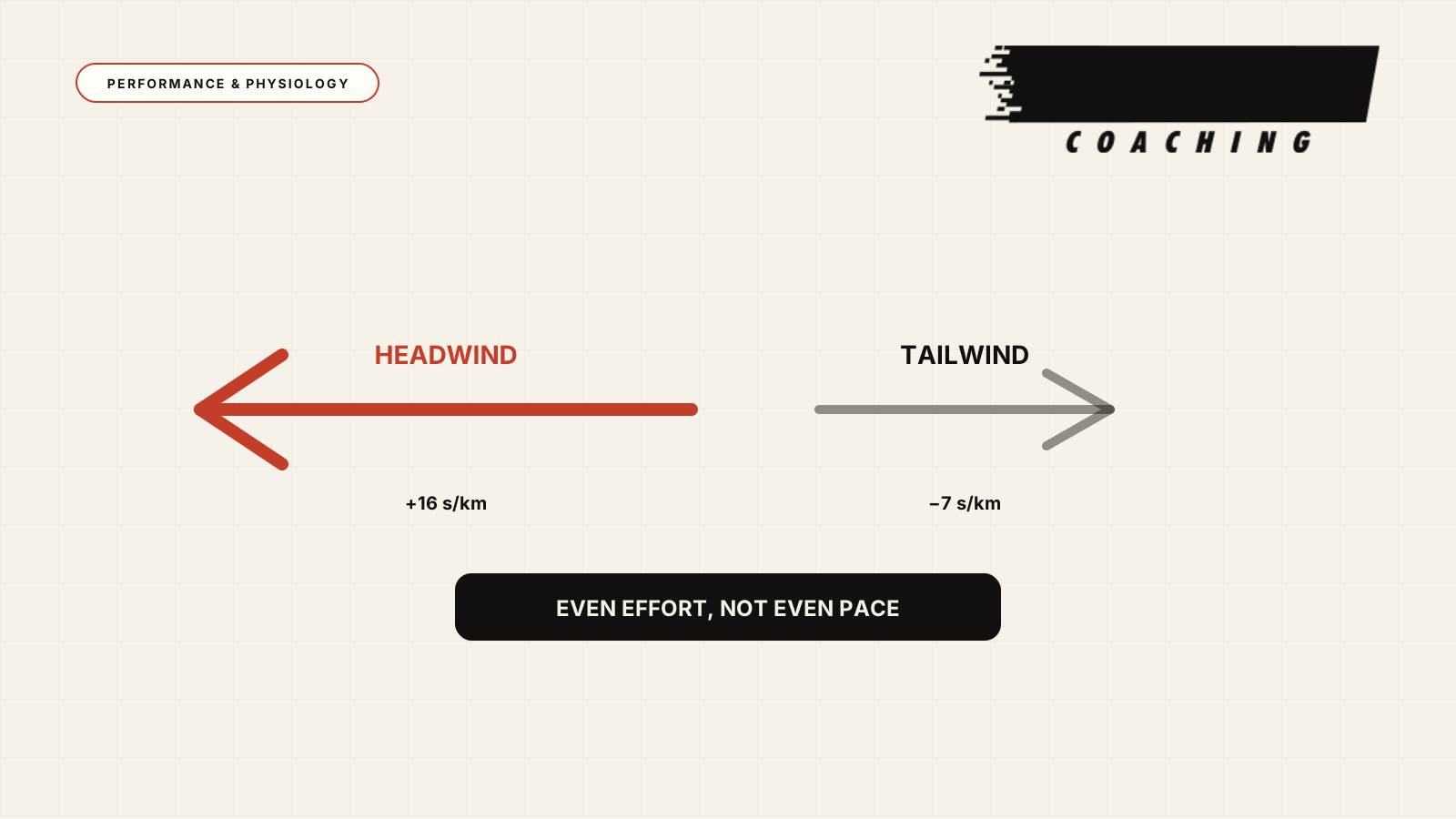
Headwinds and tailwinds usually do not cancel each other out, however. For example, with a calm-weather reference pace of 5:00/km, a 3 Bft wind and Wind Profile: Suburbs, the calculator estimates approximately 5:16/km into the wind and 4:53/km with a tailwind.
Running 500 m in each direction takes approximately 2:38 for the first half and 2:26.5 for the second. You therefore complete the kilometre in around 5:04.5, compared with 5:00 in calm conditions. Despite maintaining the same theoretical intensity, the tailwind does not return all the time lost into the wind.
The aim is not to fight the wind, but to understand when to slow down and how to keep your effort controlled.
Pace alone does not describe effort intensity
In calm conditions, a runner moving at 15 km/h already creates a relative airflow of approximately 15 km/h over their body. Running at the same speed into a 15 km/h headwind brings relative air speed close to 30 km/h. With the same wind directly behind, it can theoretically approach zero.
This means we need more than the speed in the weather forecast. We need relative air speed: the airflow resulting from running speed, wind speed and the angle between them.
The basic aerodynamic drag equation is:
Fdrag = ½ × ρ × CdA × vrel²
where:
ρis air density,CdAis the product of the runner’s drag coefficient and frontal area,vrelis relative air speed.
Aerodynamic drag force rises approximately with the square of relative speed. The power needed to overcome that force also depends on your forward speed.
Put simply, the wind’s effect does not increase by a fixed number of seconds per kilometre. The same headwind has a greater effect as you run faster and relative airflow over your body increases.
Why a headwind costs more than a tailwind gives back
In the earlier example, the first 500 m took approximately eight seconds longer than in calm conditions. Over the next 500 m, the tailwind returned only around 3.5 seconds. There are two main reasons:
- Nonlinear drag: the extra cost of a headwind rises faster than the benefit of the same wind behind you.
- Longer exposure: the slower headwind section takes longer to cover over the same distance.
Trying to hold exactly the same pace in both directions does not maintain a constant effort. You run at higher intensity into the wind and lower intensity with it behind you. The more effective strategy usually comes closer to maintaining effort than maintaining pace.
A crosswind still has an effect
When wind comes from the side, the runner is still moving forward. Relative airflow therefore reaches the body diagonally, rather than at exactly 90°.
A simple model can calculate this vector relationship and estimate its effect on pace. It cannot precisely capture changes in posture, instability from gusts, turbulence between buildings, clothing drag or the shelter offered by a group of runners. A crosswind may affect pace less than an equivalent headwind, but its effect is not negligible.
The forecast does not always reflect the wind on your route
Standard weather observations measure wind at approximately 10 m above ground under defined exposure conditions. You run much closer to the ground, where buildings, trees and terrain can reduce average wind speed or create sudden gusts and changes of direction.
A city or forest may provide more shelter but more turbulence. An open rural road, coastal section, bridge or hilltop is usually more exposed.
The calculators’ Wind Profile mathematically adjusts forecast speed to estimated body height. It cannot predict what happens behind every building or during every gust. Testing a range of plausible values is therefore more useful than relying on a single number.
If you have a more precise wind speed in km/h or m/s, use it. The Beaufort scale represents ranges of wind speed, not one specific speed.
How to use the Wind Pace Calculator on the road
The Wind Pace Calculator works in two directions:
Effort → Wind Pace
Use this before a session or race to convert a calm-weather reference pace into an expected pace in the wind.
For example, with:
Calm-day Effort: 5:00/km,Wind speed: 3 Bft,Wind direction:Head, 0°,Wind Profile:Suburbs,
the Expected Wind Pace is approximately 5:16/km. This does not mean every runner should run at exactly 5:16/km. Under the model’s assumptions, that pace corresponds to approximately the same metabolic effort as 5:00/km in calm conditions.
Wind Pace → Effort
Use this after a session or race to estimate the calm-weather effort equivalent of the pace you ran.
The reverse mode is useful for analysing a session, but is not a laboratory measurement. If the wind was constantly changing or the route had steep gradients, treat the result with greater caution.
On the road, divide the course into similar sections
One average wind value for the entire route can hide the most significant differences. The route changes direction, some sections are sheltered and others fully exposed.
Before an important race, divide the course into longer sections with similar characteristics:
- exposed straights with headwinds or crosswinds,
- sheltered urban sections,
- turnarounds that change your angle to the wind,
- bridges, coastal sections or hilltops,
- sections where a group is likely to form.
Into a headwind, slow down to keep intensity and perceived effort (RPE) controlled. With a tailwind, let pace increase gradually without turning a favourable section into an early surge. Do not try to recover every second you lost.
Prioritise longer splits and the overall effort over your watch’s instantaneous pace, which may lag or fluctuate continuously.
On the track, direction changes continuously
A full 400 m lap is more than two opposing straights. Your direction changes continuously on the bends, so a theoretically steady wind becomes a headwind, crosswind and tailwind in succession.
The Track Wind Calculator uses standard 400 m track geometry and calculates relative wind direction separately on the straights and bends.
You can choose:
Calm → Wind Splitto estimate a split in the selected wind conditions,Wind Split → Calmto find the equivalent calm-weather split,Constant effortto see how speed should theoretically change to maintain the same metabolic effort,Constant speedto see how the required effort changes when speed is held constant.
Then select Rep, Split in the wind, wind speed and direction, and the appropriate Wind Profile.
For example, a Split in the wind of 1:20 for 400 m, with 3 Bft, a crosswind on the straights and Wind Profile: Suburbs, gives an Equivalent Calm Split of approximately 1:19.56 in Wind Split → Calm mode with Constant effort.
The difference is small, but can help assess fast repetitions. Over 200 m, starting position and wind direction matter more because the effort does not cover a full lap. In a typical endurance session, do not change the entire workout target for a few tenths of a second.
Drafting helps, but choosing the right group matters more
Running behind other athletes can reduce aerodynamic drag, particularly at high speeds. The exact benefit depends on spacing, your position in the group, the number of runners and wind angle.
The calculators do not account for drafting, so they primarily describe a solo runner. In a real race, the right group can provide shelter. But if its pace requires more intensity than you intend to sustain, the lower aerodynamic cost will not protect you from overpacing.
Key takeaways
- The same pace does not require the same effort when wind strength or direction changes.
- Relative air speed depends on your speed, wind speed and the angle between them.
- Headwinds and tailwinds usually do not cancel out because drag is nonlinear and exposure time differs.
- On the road, plan longer sections by exposure and manage effort rather than every individual split.
- On the track, use the Track Wind Calculator as a small adjustment when assessing repetitions, rather than an absolute measurement.
- Drafting helps only if the group is moving at an intensity you can actually sustain.
- Both calculators provide mathematical estimates. They do not know the gusts, obstacles, your running economy or your response on the day.
Wind is not a reason to abandon your target before the start. It is a reason to turn a target pace into a more flexible, realistic race plan.
Sources and further reading
- Pugh LGCE. Oxygen intake in track and treadmill running with observations on the effect of air resistance. The Journal of Physiology. 1970;207(3):823–835.
- Davies CTM. Effects of wind assistance and resistance on the forward motion of a runner. Journal of Applied Physiology. 1980;48(4):702–709.
- da Silva ES, Kram R, Hoogkamer W. The metabolic cost of emulated aerodynamic drag forces in marathon running. Journal of Applied Physiology. 2022;133(3):766–776.
- Schickhofer L, Hanson H. Aerodynamic effects and performance improvements of running in drafting formations. Journal of Biomechanics. 2021;122:110457.
- World Meteorological Organization. Guide to Instruments and Methods of Observation (WMO-No. 8) — Measurement of surface wind.
- World Athletics. Track and Field Facilities Manual 2019 — 400 m Standard Track geometry.