Wind Pace Calculator
Calculate how headwinds, tailwinds or crosswinds may change your pace — or find the equivalent still-air effort for a pace you ran in the wind.
Advanced
5:00/km calm effort in a 3 Bft headwind
Expected Wind Pace 5:16/km
How to use it
Select Effort → Wind Pace for a prediction or Wind Pace → Effort to assess a pace run in the wind. Enter wind speed and direction. Wind Profile adjusts forecast speed for the surroundings and body height.
What you need to know
The Wind Profile adjustment is a mathematical approximation. Buildings, trees and terrain can cause gusts and turbulence that it does not capture. The model calculates relative air velocity but does not estimate the difficulty of balancing in a crosswind. It is intended for running, not cycling.
Read the related article
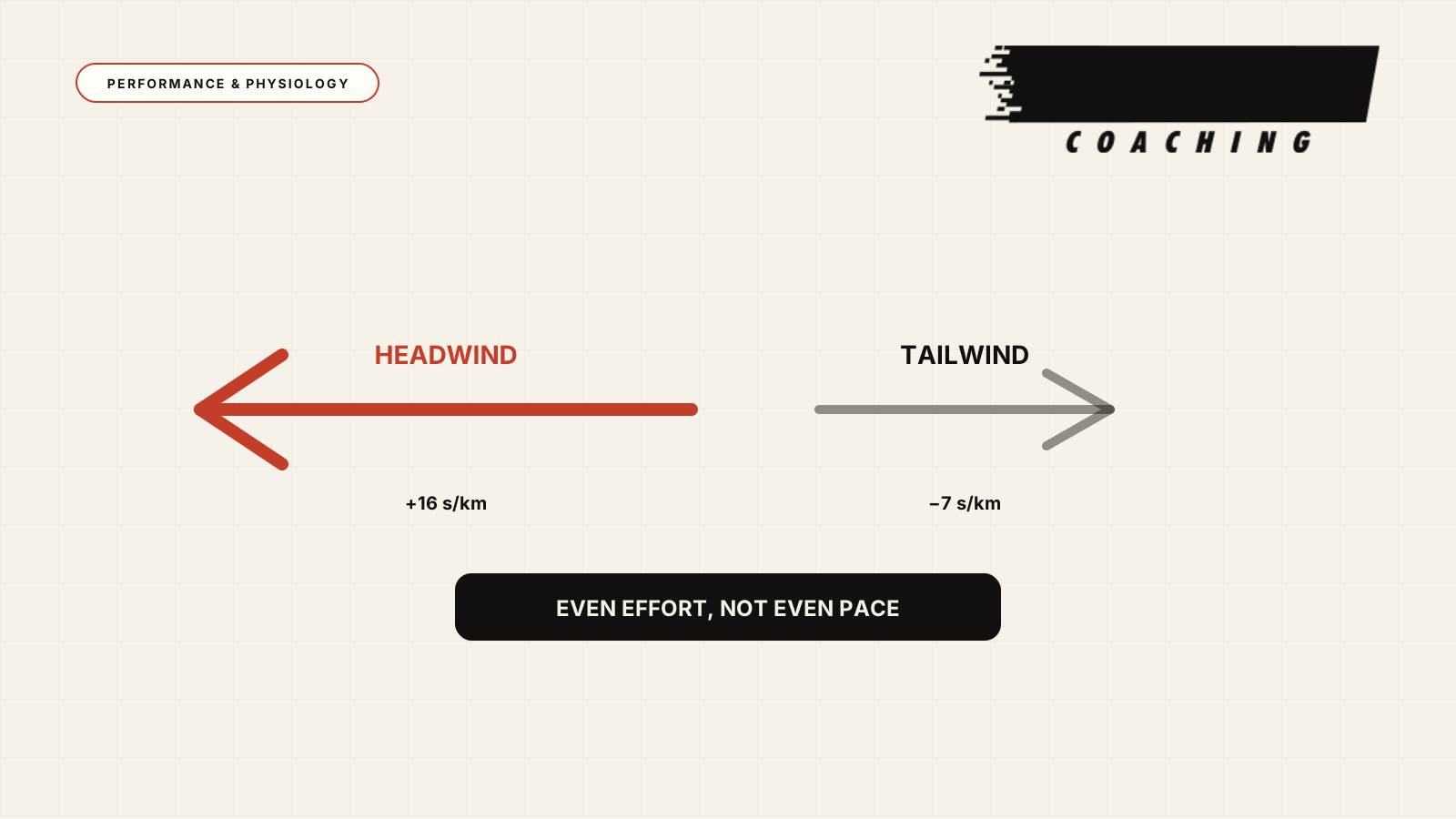
In the wind, manage effort rather than pace.
Trying to hold the same pace into a strong headwind can push intensity above your target and tire you earlier. Together, we can organise your pacing around actual effort and race-day conditions.
Methodology & Sources
The calculator combines a running metabolic-cost model with the aerodynamic drag equation. Relative air velocity is calculated as a vector from the runner’s speed, wind speed and wind angle. The aerodynamic component follows the principles of Pugh and Livingston & Lee; metabolic-cost estimation uses the models of Black et al. and Da Silva et al. Wind Profile converts forecast speed at approximately 10 m to estimated body-height speed using power-law coefficients for urban, suburban and open settings. Results have been cross-checked against the Running Writings Wind Calculator; this is not independent scientific validation.
Last updated: 27 July 2026