Suppose you are preparing for an IRONMAN 70.3 and enter the following times into the Triathlon Finish Time Planner:
Swim 35:00 + T1 5:00 + Bike 2:48:45 + T2 3:00 + Run 1:45:00 = 5:16:45
The result is the mathematical sum of those individual times. It is not a prediction that you can finish the race in 5:16:45.
A bike split of 2:48:45 assumes an average speed of 32 km/h over 90 km. If you average 30 km/h instead, the bike takes 3:00:00 and your total rises by 11:15, before accounting for any additional slowing on the run.
The real question is therefore not whether the calculator adds correctly. It is whether your input times are achievable in the race, on that course and in the conditions on the day.
The calculator adds times; it does not predict your performance
The calculation is simple:
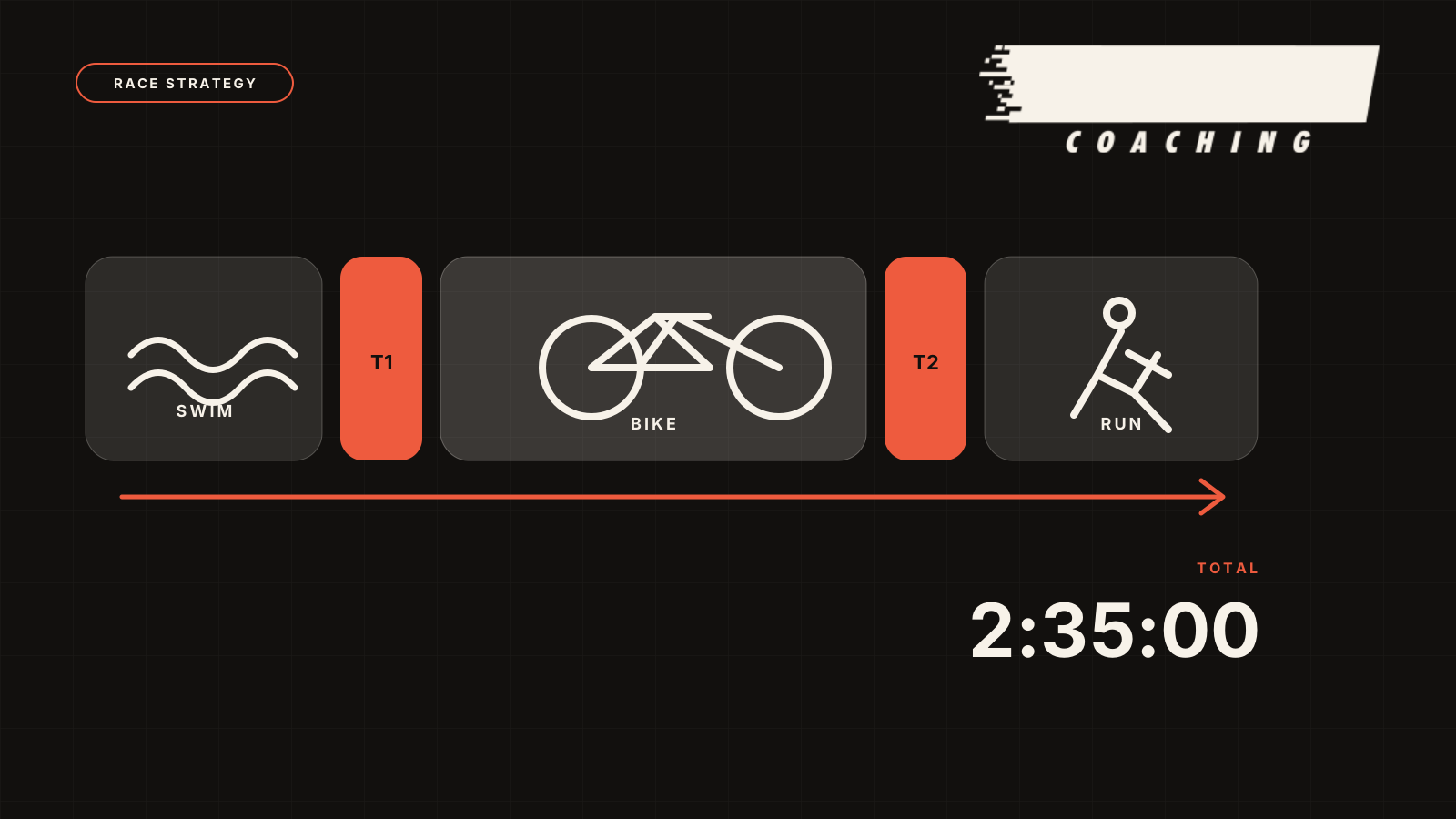
Total Finish Time = Swim + T1 + Bike + T2 + Run
The calculator can turn swim pace into a swim split, average cycling speed into a bike split, and pace per kilometre into a run split. It does not know:
- whether your swim pace comes from a pool or open water,
- whether cycling speed was recorded on a similar course in similar conditions,
- whether run pace comes from a standalone running race or a run after cycling,
- whether you have tested your fuelling,
- whether you can achieve these performances consecutively.
The total finish time can be mathematically precise yet unrealistic for racing. The right way to use the tool is to build and compare different scenarios.
Start with the correct distance and the most relevant data
The calculator’s main options are:
| Race Distance | Swim | Bike | Run |
|---|---|---|---|
| Sprint | 750 m | 20 km | 5 km |
| Standard (Olympic) | 1.500 m | 40 km | 10 km |
| IRONMAN 70.3 | 1.900 m | 90 km | 21,1 km |
| IRONMAN | 3.800 m | 180 km | 42,2 km |
Actual distances are not always exactly the same as the nominal distances at every race. Before calculating, check the athlete guide, official course maps, elevation, number of laps and transition layout. If distances differ, use Custom.
For each split, the usual order of priority is:
- A recent performance in the same race, or over the same distance on a similar course.
- A recent triathlon performance in comparable conditions.
- Race-specific training or a simulation combining race disciplines.
- A standalone swim, bike or run performance, with a larger allowance for uncertainty.
The more you rely on standalone performances, the less confidence you should place in the overall target time.
How to estimate the five parts of the race
Swim: pool pace does not always translate automatically into open-water pace
Pool pace is influenced by turns and push-offs, while open water involves sighting, waves, currents, contact with other athletes and possible deviation from the ideal line. Wetsuits and drafting can help, but their effect is not the same for everyone.
A recent open-water effort in similar conditions and with comparable wetsuit use is more useful than a fast pool set. If you only have pool pace, use it as a reference point rather than a reliable prediction of race pace.
Intensity matters too. In a study of nine well-trained male triathletes over sprint distance, swimming below swim time-trial intensity led to better cycling and overall triathlon performance. This does not prescribe a swim pace for every athlete and distance. It does show that the fastest possible swim split does not always lead to the best overall finish time.
T1 and T2: they differ between races
Transitions also include the distance from the swim exit to the transition area. In some races, you may have to run several hundred metres to reach your bike, the mount line or the run exit.
Check your previous times if you have raced there before, other athletes’ results at the same event and the athlete guide. Transition practice reduces time lost through mistakes, but cannot remove the time required to cover a longer transition distance at that race.
Bike: do not rely on average speed from a different course
Cycling speed depends on the power you can sustain, your aerodynamic position, wind, gradients, corners and road surface. The same watts can produce very different average speeds on two different courses.
A previous bike split from the same race is the best starting point. Otherwise, use data from a long training session or simulation on similar terrain and in the conditions you expect.
Your bike target should correspond to an intensity that allows you to execute the following run properly. A fast bike split involving repeated surges and leaving you too fatigued to run at a pace you are capable of sustaining is not successful triathlon pacing.
In a large analysis of age-group IRONMAN 70.3 results, bike and run splits correlated more strongly with overall finish time than the swim. This is a correlation, not proof that you should “sacrifice” one discipline for another. It does, however, reinforce that a small error in estimating the bike leg can directly affect the run and substantially change overall finish time.
Run: a standalone PB is a reference point, not a realistic triathlon run split
A 10K, half-marathon or marathon PB was set without a swim and bike beforehand. In triathlon, your run is affected by bike duration and intensity, muscular fatigue, temperature, hydration and fuelling.
There is no universal rule such as “add 10% to your standalone time over X km to calculate triathlon pace”. An experienced triathlete with appropriate bike pacing may get much closer to their running capability. An athlete without enough race-specific brick sessions, or who bikes too aggressively, may fall much further short.
Prioritise a previous triathlon run split or a race-specific session following a sufficiently long ride near race intensity. A short brick helps you practise the transition, but does not by itself establish that you can sustain the same pace throughout the race’s entire run leg.
Fuelling and weather change your finish-time scenario
In long races, fuelling is not a separate detail. It directly affects the intensity you can sustain on the bike and, especially, on the run that follows. The calculator does not know whether your carbohydrate and hydration plan has been tested, or whether your gut can tolerate it for that many hours.
The same applies to weather. Currents and waves change swim duration, wind and elevation affect bike duration, and heat and humidity increase the effort required to run. If the forecast differs substantially from your training conditions, adjust your calculator inputs before the start, rather than waiting until the original plan is already unsustainable.
Build Plan A, Plan B and Plan C
Do not settle on a single target simply because the calculator gives a finish time down to the second. Build three complete, coherent scenarios:
Plan A — ambitious but supported by evidence. Use the best realistic values you have validated in relevant training or a similar race. This should not simply be the sum of your standalone PBs in the three sports.
Plan B — your main, most likely scenario. Enter times supported by consistent preparation, race-specific sessions and the expected race weather.
Plan C — a conservative scenario. Estimate what changes if the water is more challenging, the wind stronger, the temperature higher or your target run pace proves unsustainable. You do not need to include every unforeseen mechanical problem. You simply need to allow for the uncertainty of an endurance race.
All three scenarios must be internally consistent. Do not combine your best possible swim, fastest bike and running PB in Plan A unless you have evidence that they can coexist in an actual triathlon.
How to use the Triathlon Finish Time Planner
- Under
Race Distance, chooseSprint,Standard (Olympic),IRONMAN 70.3,IRONMANorCustom. - Under
Swim, enterPace /100morSwim Time. - Add your
T1time, including travel through transition. - Under
Bike, enterAverage SpeedorBike Time. - Add your
T2time. - Under
Run, enterPace /kmorRun Time. - Check
Total Finish Timeand the detailed breakdown, then useCopy Resultto save each scenario.
If your main aim is to finish within the event’s cut-offs, do not look only at the overall result. Check the athlete guide for individual and intermediate cut-offs. A theoretical total below the final limit does not guarantee that you reach every earlier checkpoint in time.
Checklist: is your finish time realistic?
- Have you used the event’s actual distances and course?
- Do your swim, bike and run inputs come from recent, relevant training or races?
- Does swim pace account for the race’s open-water conditions?
- Does average bike speed come from similar terrain and correspond to an intensity that lets you run well afterwards?
- Is run pace based on a triathlon effort or race-specific brick, rather than only a running PB?
- Have you allowed realistic T1 and T2 times?
- Have you tested your fuelling plan?
- Have you adjusted the scenario for heat, wind and elevation?
- Do you have Plan B and Plan C?
- Have you checked every event cut-off?
Key takeaways
- Total time is the sum of five individual times. The challenge lies in choosing realistic inputs.
- Triathlon is one continuous race. The fastest possible split in each sport does not necessarily produce the fastest overall time.
- Previous performance at the same race and race-specific training are more valuable than standalone PBs.
- Bike pacing must also be judged by the run that follows.
- Fuelling, weather, course and transitions need to be considered before committing to a finish-time target.
- Use the calculator to build Plans A/B/C, rather than as a precise finish-time prediction.
Use the Triathlon Finish Time Planner to organise your scenarios. For longer races, you can plan fuelling with the Race Fueling Calculator and read Race Fueling: how much carbohydrate you need and how to train your gut.
Sources and further reading
- World Triathlon. Competition Rules and official documents. 2026.
- IRONMAN. About IRONMAN — official IRONMAN and IRONMAN 70.3 distances.
- Wu SSX et al. Factors influencing pacing in triathlon. Open Access Journal of Sports Medicine. 2014.
- Peeling PD, Bishop DJ, Landers GJ. Effect of swimming intensity on subsequent cycling and overall triathlon performance. British Journal of Sports Medicine. 2005.
- Millet GP, Vleck VE. Physiological and biomechanical adaptations to the cycle-to-run transition in Olympic triathlon. British Journal of Sports Medicine. 2000.
- Nikolaidis PT et al. Predicting overall performance in IRONMAN 70.3 age-group triathletes through split disciplines. Scientific Reports. 2023.
- Jeukendrup AE, Jentjens RLPG, Moseley L. Nutritional considerations in triathlon. Sports Medicine. 2005.