If your watch estimates 850 kcal burned per hour, that does not mean you should consume 850 kcal every race hour. First, the watch is probably not estimating expenditure accurately. Second, you cannot replace 100% of calories burned during a race—and, more importantly, you do not need to.
You start with stored glycogen and much larger fat reserves. During exercise, the body uses different combinations of these fuels, mainly according to intensity and duration. Carbohydrate intake is not intended to replace every unit of energy in real time. It maintains carbohydrate availability so you can support intensity longer and limit performance decline as fatigue increases.
Grams per hour therefore do not come from your watch’s calorie estimate. They depend on race duration, intensity, sport and—above all—how well you can consistently consume and tolerate that amount without stomach problems while racing.
Duration sets the initial carbohydrate range
General guidelines use effort or race duration as the starting point:
| Expected duration | Initial intake framework |
|---|---|
| Up to around 45–60 minutes | Intake during exercise is usually unnecessary |
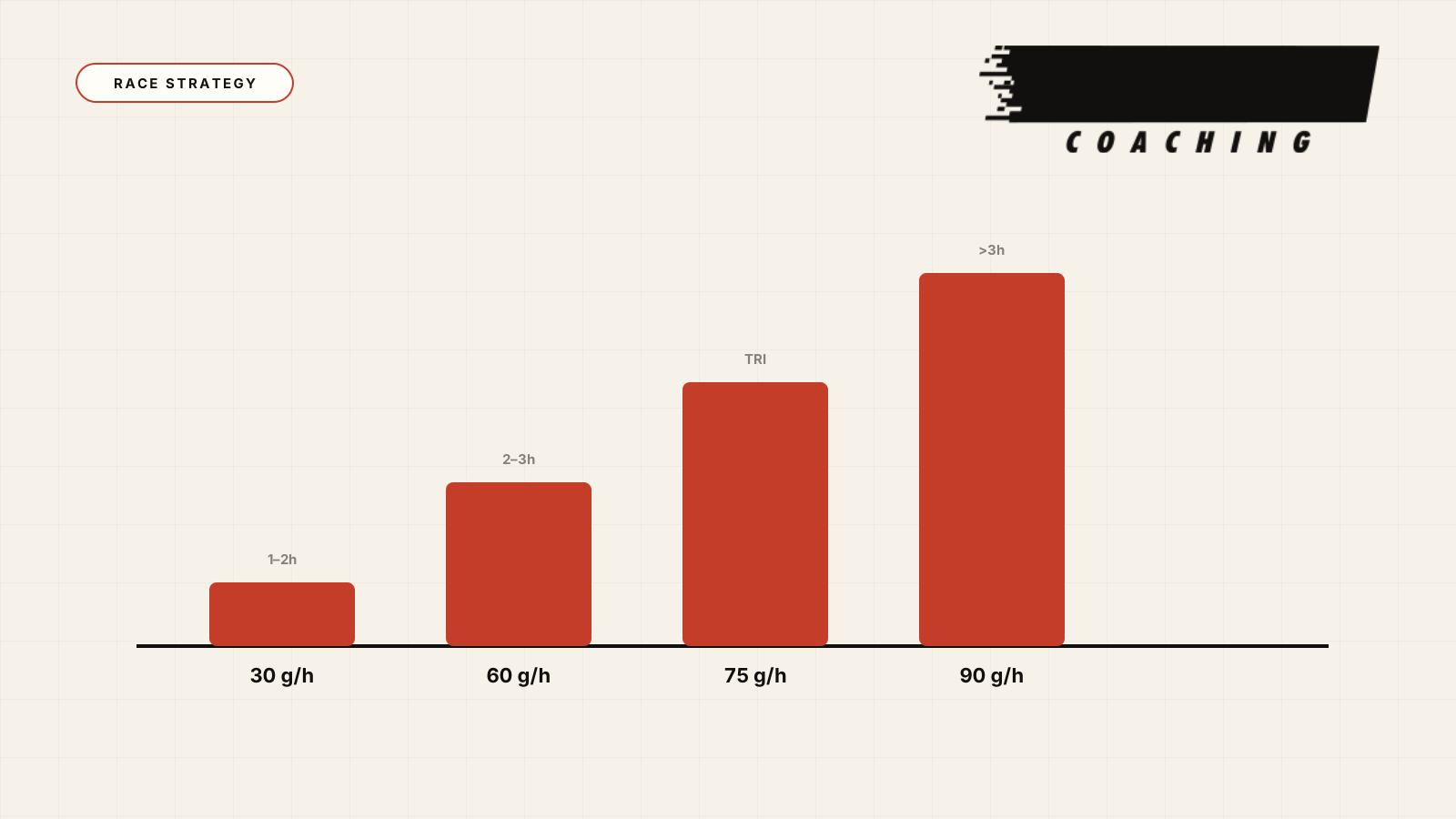
| Around 1–2 hours | Around 30 g/h |
| Around 2–2.5 hours | Around 30–60 g/h |
| Over 2.5 hours | Around 60–90 g/h, with tolerance and an appropriate source combination |
These values are not your personal fuelling plan. They are a general starting point to adapt to the race and athlete.
Two athletes may race the same triathlon distance, but one finishes in two hours and the other in three and a half. Their total carbohydrate needs differ. Start with realistic expected duration, not race distance.
For most recreational athletes, fuelling becomes particularly important beyond two hours, when the plan must be sustained for a long time.
g/h are neither kcal nor a simple body-weight calculation
Sports nutrition often expresses carbohydrate in grams per kilogram of body mass. During racing, however, guidelines usually use grams per hour (g/h), because a key limit is how quickly carbohydrate can pass through the gut and be used.
A 90 kg athlete cannot automatically absorb 50% more carbohydrate than a 60 kg athlete. Weight, absolute intensity and energy cost still matter, but do not simply multiply intestinal capacity.
More carbohydrate is not always better. Aim for an amount that meets the race’s demands and can be consumed consistently without stomach problems.
Above 60 g/h, you need different carbohydrate sources
Glucose and maltodextrin mainly use the same intestinal transporter. Relying on them alone while substantially increasing intake eventually reaches a practical absorption limit.
Fructose uses a different transporter. Combining glucose or maltodextrin with fructose allows greater total carbohydrate absorption and oxidation. Targets near 90 g/h therefore usually rely on multiple transportable carbohydrates, not glucose alone.
In recent years, professional athletes have used 120 g/h or more. Newer research is examining additional benefits in highly trained athletes. Evidence does not yet support 120 g/h as a general target, especially for recreational runners or triathletes.
Before increasing intake, answer three questions:
- Is the race long and demanding enough to justify more carbohydrate?
- Does the product contain the appropriate combination of carbohydrate sources?
- Can you repeatedly consume this amount at race intensity and in race conditions without gastrointestinal problems?
If any answer is “no”, copying a professional’s online fuelling plan will not help you race better.
Gut training is part of race preparation
Race day should not be your first fuelling-plan test. The gastrointestinal system can adapt to repeated carbohydrate intake during exercise, while practice also improves practical execution.
Start with an amount you already tolerate and increase gradually in sessions that best resemble race demands. Use the same products, similar concentration and consumption intervals intended for racing. Record not only total g/h but intensity, temperature, additional fluids and symptoms such as bloating, nausea, cramps or needing the toilet.
A long ride, brick or long run tests more than whether you can consume a gel. It shows whether you can:
- start fuelling on time and continue when tired,
- open and consume products without disrupting pace,
- tolerate the taste and concentration after several hours,
- combine carbohydrate and fluids appropriately,
- repeat the plan without significant symptoms.
One successful test is encouraging, not a race-day guarantee. Look for repeated good tolerance across more than one specific session.
If you frequently experience severe gastrointestinal symptoms, do not simply try to overcome them by increasing carbohydrate exposure. Review the plan with a sports dietitian or nutritionist.
Triathlon cycling and running need different fuelling plans
Usually, you cannot fuel during a triathlon swim. In the Race Fueling Calculator, Pre-start means carbohydrate consumed shortly before starting, not during the swim. It also excludes the pre-race meal.
Cycling is usually the main opportunity to fuel more effectively and consume more carbohydrate in triathlon. It lasts longer, allows you to carry more products and makes consumption easier than running. Bike-leg choices directly affect the run afterwards.
Running’s impact, greater intensity and less comfortable consumption can make the same carbohydrate amount harder to tolerate. Your g/h targets need not match across the two legs. A good plan is sport-specific, not one average for the whole race.
The calculator does the arithmetic; you build the plan
The Race Fueling Calculator multiplies duration by your g/h target. Triathlon mode adds Pre-start grams and calculates Bike and Run separately. Single sport calculates the total from your chosen duration and g/h.
For example:
Pre-start: 30 g,Bike: 2 hours × 60 g/h = 120 g,Run: 1 hour × 40 g/h = 40 g,- total: 190 g carbohydrate.
The 190 g is the calculation, not yet your race fuelling strategy. Next define products, grams per serving, consumption times, how much you will carry and how, and what you will collect at aid stations.
You also need a simple backup plan for a lost bottle, a longer race or a stomach that no longer tolerates intake. The calculator does not estimate water, sodium or caffeine needs. These interact with fuelling but must be planned and tested separately.
Common race-fuelling mistakes
- Trying to replace every calorie your watch estimates.
- Choosing g/h from a professional’s intake rather than your race’s demands.
- Increasing g/h abruptly without gut training.
- Waiting for hunger or declining performance before starting.
- Using identical bike and run targets despite different tolerance.
- Trying a new product, concentration or combination on race day.
- Calculating total grams correctly but failing to organise carrying and timing.
Checklist: is your plan race-ready?
- Is your
g/htarget based on realistic race duration and intensity? - Above 60 g/h, are you using an appropriate mix of carbohydrate sources?
- Have you tested the same amount, products and similar timing in more than one specific session?
- Do bike and run plans differ if your tolerance differs?
- Do you know the grams in every gel, bottle or serving?
- Have you combined fuelling with a tested fluid plan?
- Is there a backup for a lost product, changed race duration or gastrointestinal discomfort?
The more uncertain answers, the less ready your fuelling plan is—even with correct arithmetic.
Key takeaways
- Calories burned are not the calories you need to consume during a race.
- Duration sets the initial amount; tolerance and race demands determine the final plan.
- Above 60 g/h, a glucose or maltodextrin and fructose combination is usually needed.
- Neither 90 nor 120 g/h suits everyone; do not copy these targets without a specific reason and systematic training tests.
- Gut training requires gradual increases and repetition in race-like conditions.
- The calculator totals grams. Training shows whether you can turn them into a realistic fuelling strategy.
Use the Race Fueling Calculator to calculate total carbohydrate, then translate it into specific products, timings and a plan already tested in training.
Sources and further reading
- Jeukendrup AE. A Step Towards Personalized Sports Nutrition: Carbohydrate Intake During Exercise. Sports Medicine. 2014.
- Thomas DT, Erdman KA, Burke LM. Position of the Academy of Nutrition and Dietetics, Dietitians of Canada, and the ACSM: Nutrition and Athletic Performance. Journal of the Academy of Nutrition and Dietetics. 2016.
- Jeukendrup AE. Training the Gut for Athletes. Sports Medicine. 2017.
- Costa RJS et al. Gut-training: the impact of two weeks repetitive gut-challenge during exercise. Applied Physiology, Nutrition, and Metabolism. 2017.
- Currell K, Jeukendrup AE. Superior Endurance Performance with Ingestion of Multiple Transportable Carbohydrates. Medicine & Science in Sports & Exercise. 2008.
- Morton JP et al. From Metabolism to Medals: Contemporary Perspectives and Revisiting Carbohydrate Guidelines for Fuelling Endurance Athletes During Exercise. The Journal of Nutrition. 2026.
- Plews DJ et al. Fuelled or Fooled? Examining the Evidence and Mechanisms Behind Ultra-High Carbohydrate Intake in Endurance Athletes. Sports Medicine. 2026.