If you recently ran 5K in 20:00, the Race Predictor will “predict” around 41:42 for 10K, 1:32:00 for a half marathon and 3:11:49 for a marathon.
All three predictions use the same input performance and the same Riegel equation. They are not equally reliable.
The 10K prediction extrapolates between fairly close distances: 5K → 10K. For the marathon, the model extends a 20-minute effort to a race lasting over three hours. More than pace changes over that span: energy demands, muscular load, fuelling and the ability to hold pace under substantial fatigue all change.
The predictor does not know whether you completed the necessary long runs, tested fuelling or face major elevation changes, as at the Athens Authentic Marathon. It knows only one time and one distance. Use its result as an initial reference, not your final race target.
What a Race Predictor actually calculates
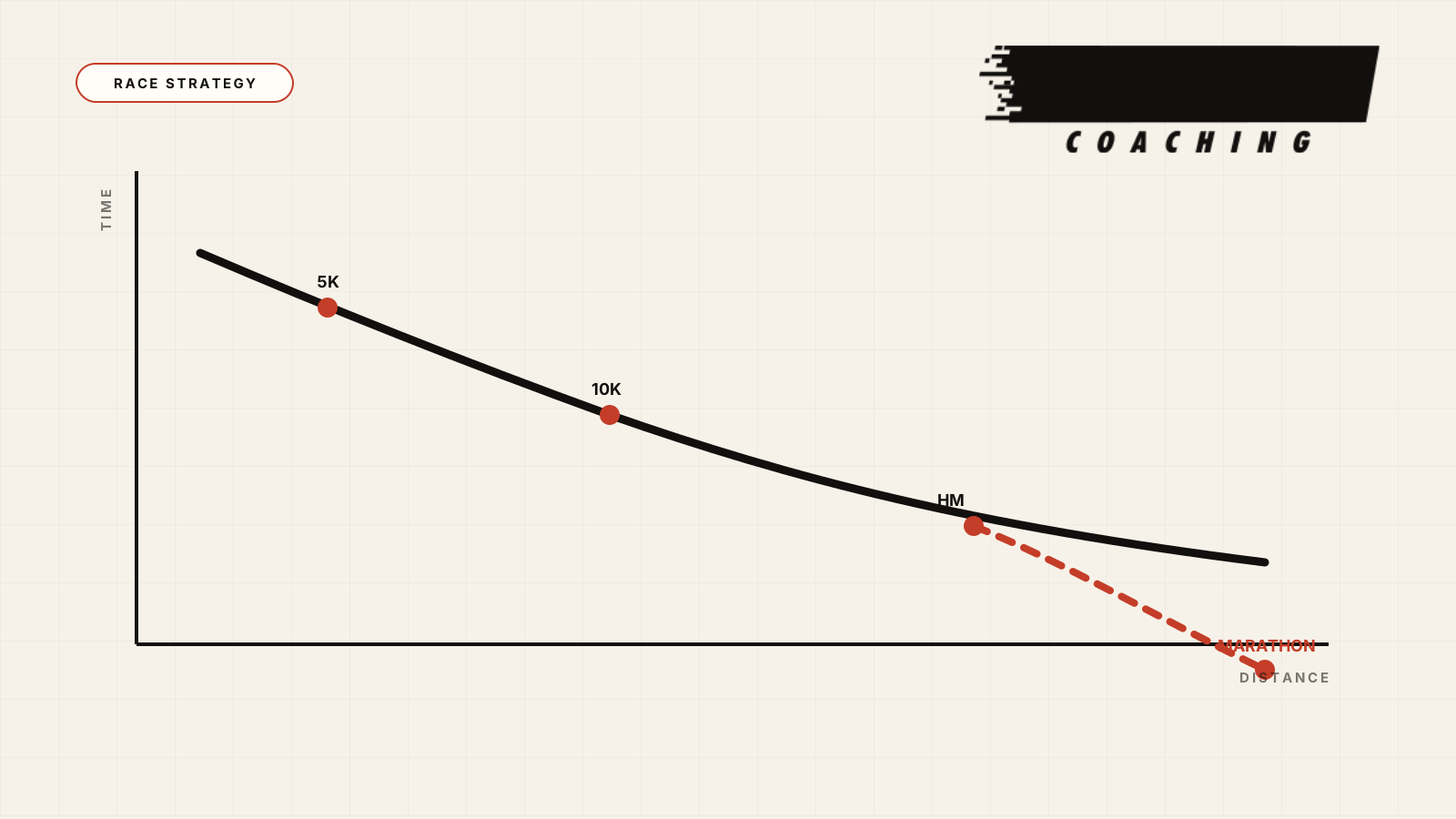
As race distance increases, sustainable average speed decreases. A performance curve can describe the distance–time relationship.
A speed-oriented runner may perform very well over 1500 m or 5K but lose a larger share of speed over longer races. Another runner with the same 5K time may have greater endurance and slow less over a half marathon.
With one performance, the calculator cannot know which profile represents you. It uses a general assumption about speed decline with distance to produce a mathematically equivalent performance.
Its result therefore answers:
“As performance declines, what time corresponds to the new distance under the Riegel model’s assumptions?”
It does not answer “What time will I run next?” with certainty.
How the Riegel equation works
Most simple race predictors use the Riegel equation or a variation:
T₂ = T₁ × (D₂ / D₁)^k
Where:
T₁is the time of a completed performance,D₁is its distance,D₂is the distance to predict,kis the exponent determining predicted speed decline as distance increases.
If k were 1.00, the equation would assume identical pace and speed at all distances. A 20-minute 5K would become a 2:48:48 marathon—clearly unrealistic.
k = 1.06 is a common central assumption. It is not a personal endurance measurement or individual “fatigue index”. The tool knows nothing about you personally.
A small increase in k adds more predicted time as distance grows
The Race Predictor shows a central prediction with k = 1.06 and a range from 1.05–1.08. For 5K in 20:00:
| Distance | k = 1.05 |
k = 1.06 |
k = 1.08 |
|---|---|---|---|
| 10K | 41:25 | 41:42 | 42:17 |
| Half marathon | 1:30:41 | 1:32:00 | 1:34:42 |
| Marathon | 3:07:46 | 3:11:49 | 3:20:11 |
At 10K, the fast-to-slow spread is under a minute. At the marathon, it exceeds 12 minutes.
The range is not a success probability or a statistical interval you can rely on individually. It simply shows what happens when the model’s k and speed-decline assumptions change. Actual uncertainty may be greater because training, course, weather and race strategy are unknown.
Predictions are more reliable between nearby distances
The equation is most useful when known and target distances have similar demands. A recent maximal 5K can give a useful initial 10K estimate. A 10K may predict a half marathon somewhat better than a 1500 m or 5 km race.
Uncertainty increases when:
- target and input distances differ greatly,
- the input performance was not truly maximal,
- fitness has changed since then,
- courses or weather differ substantially,
- preparation suits one distance but not the other.
If you have two recent performances, such as 5K and 10K, use both. Noticeably different half-marathon or marathon predictions are useful information. They may suggest a speed- or endurance-oriented profile, a result that no longer represents current fitness, or incomparable race conditions.
Why the model struggles with the marathon
A marathon is not simply a little over four 10K races or 2 half marathons. Performance depends much more on:
- consistency and total preparation volume,
- long-run duration and frequency,
- muscular and neuromuscular fatigue resistance,
- energy availability and fuelling strategy,
- hydration and temperature management,
- pacing and avoiding an excessively fast start.
None of these factors is included in the simple Riegel equation.
In a study of 2,303 recreational runners, the classic Riegel equation performed reasonably well up to the half marathon. Marathon predictions were systematically too fast: for half the participants, predicted finish time was at least 10 minutes faster than the actual result.
This does not make the equation useless. It means a mathematically equivalent performance needs a second filter: your actual marathon readiness.
Equivalent performance does not mean race readiness
A 5K time may show the basic speed for a marathon target. It does not show whether you have developed the specific endurance to sustain the corresponding pace for 42.195 kilometres.
Before using the prediction to set a target, check:
- Has preparation been consistent over recent months?
- Have you completed enough long runs without unusual fatigue?
- Have you practised fuelling and hydration?
- Have specific sessions confirmed controlled effort at target pace?
- Have you adjusted for the course and expected weather?
The more uncertain answers, the less confidence you should place in the fast end of the range.
Result quality starts with the input
The equation assumes the entered time represents your true current ability.
A submaximal 10K, a race during a heavy training period or a hot-weather performance is not as reliable an input as a recent maximal race in good conditions. The same applies to an old time that no longer represents fitness.
Before using a performance, confirm that:
- it is recent,
- the distance was reliably measured,
- the effort was maximal and well paced,
- conditions did not substantially distort the result,
- fitness has not changed greatly since.
Prediction quality cannot exceed input quality.
How to use the Race Predictor effectively
- Choose your most recent reliable race performance.
- Prefer a distance fairly close to the target. For a marathon, a recent half marathon usually offers more value than a 5K.
- Read the central prediction with the full range, not as a single mandatory target.
- Compare it with specific sessions, long runs and preparation consistency.
- For the marathon, assess fuelling, course, temperature and fatigue resistance separately.
- Turn the prediction into Plans A/B/C rather than one target to follow regardless of what happens in the race.
Use the Race Predictor for central predictions and ranges from 1500 m to the marathon. Then read Realistic race pace to turn that initial estimate into a race plan.
Key takeaways
- Riegel converts a known performance into mathematically equivalent times at other distances.
k = 1.06is a general assumption, not a personal endurance measurement.- The further the target distance is from the input distance, the greater model error and uncertainty become.
- The displayed range reflects different model assumptions, not your personal success probability.
- An equivalent performance does not prove preparation for the new distance.
- In the marathon, consistency, long runs, fuelling, muscular endurance and pacing matter far more than one 5K or 10K time.
- Use the predictor as a starting point. Training and actual conditions determine whether the target is realistic.
Sources and further reading
- Riegel PS. Athletic Records and Human Endurance. American Scientist. 1981.
- Vickers AJ, Vertosick EA. An empirical study of race times in recreational endurance runners. BMC Sports Science, Medicine and Rehabilitation. 2016.
- Blythe DAJ, Király FJ. Prediction and Quantification of Individual Athletic Performance of Runners. PLOS ONE. 2016.
- Doherty C et al. An evaluation of the training determinants of marathon performance: A meta-analysis with meta-regression. Journal of Science and Medicine in Sport. 2020.
- Fokkema T et al. Training for a (half-)marathon: Training volume and longest endurance run related to performance and running injuries. Scandinavian Journal of Medicine & Science in Sports. 2020.