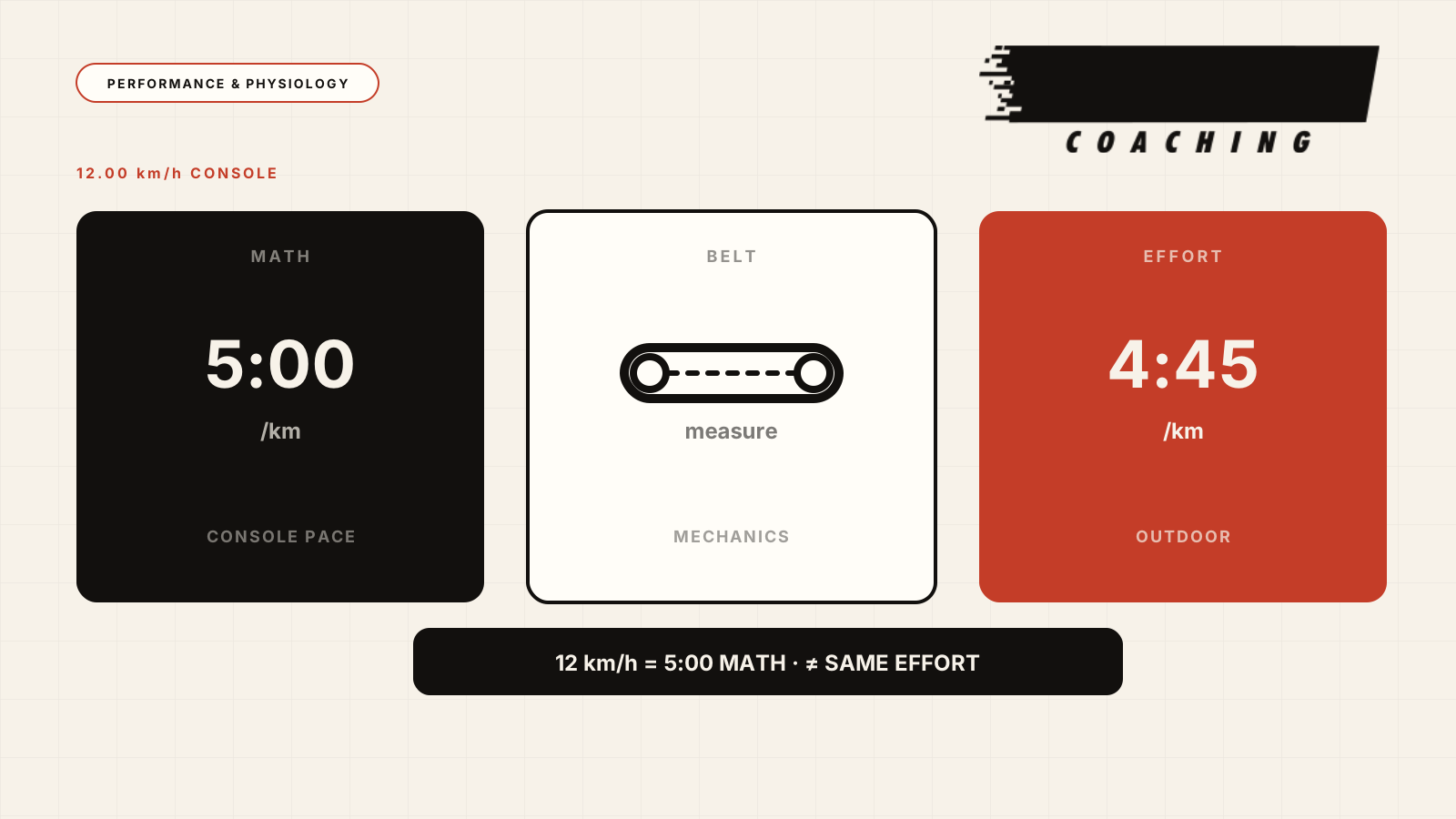
Suppose you set the treadmill to 12 km/h. The mathematical conversion is simple:
pace = 60 ÷ speed = 60 ÷ 12 = 5:00/km
The calculation is always correct. It does not prove that the treadmill belt is actually moving at 12 km/h, or that your effort corresponds to running at 5:00/km on the road or track.
This is where confusion usually arises. Displayed treadmill speed, actual belt speed and the outdoor pace requiring a similar effort are different things. Treating them as identical can lead to rules such as “always use 1%” or “subtract 15 seconds per kilometre on a treadmill”. Neither rule applies in every situation.
Displayed speed, actual speed and effort are three different things
When the treadmill display reads 12 km/h, we need to consider separately:
- The displayed setting: the speed you have asked the treadmill to run at.
- Actual belt speed: the distance the belt travels over time.
- Effort-equivalent outdoor pace: the road or track pace producing similar RPE, breathing and heart-rate responses.
These three values may be close, but they do not have to match exactly. To understand why they differ, first decide what you want to assess: the machine’s accuracy or your training intensity.
The display does not always confirm actual belt speed
The display is not necessarily an accurate measurement of the belt moving beneath your feet. Actual belt movement can be affected by:
- motor power and stability,
- belt lubrication and wear,
- friction against the treadmill deck,
- the runner’s weight and the forces applied with each foot strike,
- machine maintenance and calibration.
Speed can also fluctuate momentarily within a stride. A study of different treadmill types found that belt-speed fluctuations depend on the model, speed and body weight. This does not mean every home treadmill has a significant speed error. It does mean the display alone cannot rule out a possible discrepancy.
If you consistently notice large differences, the appropriate way to check speed is with a dedicated sensor or a technician’s assessment. Heart rate, RPE and your watch cannot measure belt movement.
Even correct belt speed does not guarantee the same effort outdoors
Suppose the belt has been measured and really is moving at 12 km/h. Even then, we have not established that your body will experience the intensity exactly as it does when running outdoors at 5:00/km.
Treadmill and overground running are broadly comparable, but not identical. Systematic reviews show that many physiological and biomechanical variables are similar, while some differences depend on speed, treadmill type, surface and the runner’s familiarity with the treadmill.
In practice, the main differences are:
- Air resistance. Outdoors, you move your body through the air. On a treadmill, the surrounding air remains almost still.
- Cooling. Without a strong fan, sweat evaporation is limited and heart rate may gradually rise.
- Surface. The stiffness and response of a treadmill differ from tarmac, a synthetic track or dirt.
- Familiarity. A fixed visual scene and the sensation of the moving belt can change your stride and perception of speed.
A more recent study found that below 14.4 km/h, the metabolic effect of air movement was within normal physiological and measurement variability. A fan is still very useful, however. Greater airflow when running outdoors helps sweat evaporate and cools the body. This difference can substantially affect heart rate and RPE, particularly during a longer treadmill session.
A 1% incline is a useful approximation, not a strict rule
The familiar advice to “set a 1% incline to simulate outdoor running” comes mainly from the Jones and Doust study. Nine trained men ran for six minutes at speeds of approximately 10.5 to 18 km/h. On average, a 1% incline brought treadmill energy cost close to that of running on a level road.
This is useful, but does not establish that every runner should use 1% for every treadmill session. At the two lowest speeds in that study, outdoor energy cost did not differ significantly from either 0% or 1%. A later systematic review also found similar oxygen consumption during submaximal treadmill running at both 0% and 1%, compared with outdoor running.
A 1% incline:
- increases the energy cost of the effort,
- does not correct inaccurate belt speed,
- does not correct high temperature or limited cooling,
- does not guarantee the same RPE or heart rate for every athlete,
- may not actually be 1% if the machine’s incline is incorrectly calibrated.
For an easy or steady run, 0–1% is a reasonable starting range, rather than a mandatory setting. Your final choice should keep intensity aligned with the purpose of the session.
My own example at 12 km/h
On my NordicTrack Commercial 1750, 12 km/h mathematically converts to 5:00/km, but independent measurement showed that actual belt speed does not match the display. Repeated comparisons of RPE and heart rate showed me that 12 km/h on the treadmill produces a similar intensity to running at 4:45/km on the track.
| Measure | Value |
|---|---|
| Treadmill display | 12.00 km/h |
| Mathematical pace of the displayed speed | 5:00/km |
| Observed effort-equivalent track pace | approximately 4:45/km |
| Speed corresponding to 4:45/km | 12.63 km/h |
This is enough to adjust my indoor training paces. Independent measurement confirmed a mechanical belt-speed error. It does not establish that the entire difference in effort is due to that error alone.
So, on my treadmill, 12 km/h produces an effort similar to approximately 4:45/km on the track.
How to establish your own comparison
You do not need a permanent conversion for every treadmill speed. You need a few reliable reference points for that particular treadmill and the conditions in which you train.
- Use the same treadmill, incline and a similar temperature.
- Use a strong fan and keep its position and setting consistent.
- Do the same warm-up and wear the same shoes.
- Compare intensity and pace with running on a level outdoor route or track.
- Assess a sufficiently long steady section, rather than the first few minutes affected by
heart-rate lag. - Record average heart rate, RPE and breathing, accounting for
cardiac drift. - Repeat the comparison two or three times with similar fatigue levels.
Establish separate reference points for easy, steady and threshold intensity. An adjustment that seems correct at 12 km/h may not apply at 10 or 16 km/h.
For high-intensity sessions, consistency is more valuable than the illusion of a perfect equivalence. Use the same treadmill, incline and fan so you can compare your progress meaningfully. If you are preparing for a race, key race-specific sessions should also be validated in the actual racing environment: on the road or track.
What the Pace Conversion Calculator can and cannot tell you
The Pace Conversion Calculator answers “what pace corresponds to this speed?”. It cannot verify a treadmill’s accuracy or predict your equivalent outdoor effort.
- Enter
12 km/hand you get the correct mathematical result:5:00/km. - If a belt-speed check measures an actual speed of
12.3 km/h, the calculator converts it to approximately4:53/km. - If repeated comparisons indicate an effort equivalent to
4:45/kmoutdoors, the calculator shows that this pace corresponds to approximately12.63 km/h.
The second result describes belt speed and its equivalent pace. The third describes how your body responds in that particular environment.
Checklist: are you using treadmill pace appropriately?
- Do you know whether you are comparing the display, actual speed or effort?
- Do you use a fan and consistent conditions for key sessions?
- If you use a 1% incline, does it serve the session’s purpose or are you simply following a general rule?
- Are you comparing steady sections rather than instantaneous heart-rate or pace readings?
- Do you have more than one reference point for easy, steady and threshold efforts?
- Do you validate your key target paces outdoors before a race?
Key takeaways
- 12 km/h always converts mathematically to 5:00/km.
- The treadmill display alone does not confirm actual belt speed.
- The same actual speed does not guarantee the same effort indoors and outdoors.
- A 1% incline is a useful approximation in specific conditions, not a universal rule.
- Heart rate and RPE help compare effort, but do not measure machine speed.
- The aim is to understand the training stimulus your own treadmill provides, rather than apply a generic correction to everyone.
Use the Pace Conversion Calculator to convert between km/h, mph, min/km and min/mile. To assess training intensity properly, also read Running Pace Zones: how they are defined, what they describe and how to use them correctly.
Sources and further reading
- Jones AM, Doust JH. A 1% treadmill grade most accurately reflects the energetic cost of outdoor running. Journal of Sports Sciences. 1996.
- Miller JR et al. A systematic review and meta-analysis of crossover studies comparing physiological, perceptual and performance measures between treadmill and overground running. Sports Medicine. 2019.
- Van Hooren B et al. Is motorized treadmill running biomechanically comparable to overground running? Sports Medicine. 2020.
- Willwacher S et al. A new method for measuring treadmill belt velocity fluctuations: effects of treadmill type, body mass and locomotion speed. Scientific Reports. 2021.
- Yamashita N et al. Air speed and direction affect metabolic and thermoregulatory responses during walking and running in a temperate environment. Journal of Applied Physiology. 2024.