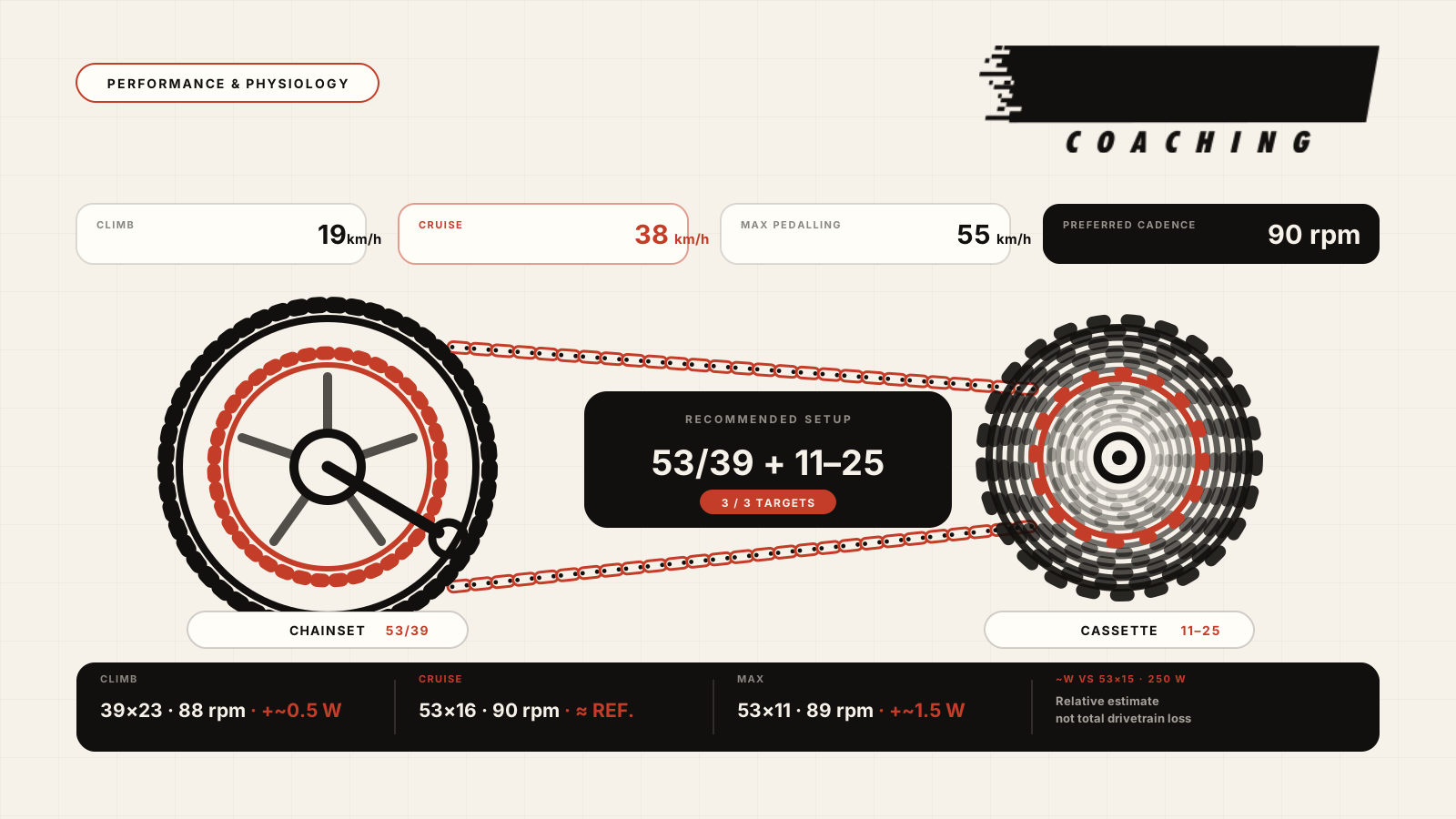
Suppose that on an undulating course you expect to climb at 19 km/h, ride most of the race near 38 km/h and keep pedalling up to 55 km/h. Your preferred cadence is 90 rpm.
With these inputs, the Race Gearing Calculator can compare available chainring and cassette combinations or check your current setup. For example, it might suggest 53/39 + 11–25 and show which gear covers each of your three targets, at what cadence and with what estimated relative loss.
This does not mean that gearing will enable you to sustain 38 km/h. It means that, if you can produce the required power, the setup has a suitable gear for that speed near your chosen cadence.
Gearing needs to cover the whole course
A race setup is not judged only by its highest or lowest gear. It should allow you to:
- climb sustained gradients without cadence dropping below a manageable level,
- ride at your main race speed in a practical gear without unnecessary cross-chaining,
- keep pedalling at your chosen top speed without exceeding your cadence limit,
- shift without excessively large jumps between cassette sprockets.
A wide-range cassette can offer an easier climbing gear, but usually creates larger cadence changes between adjacent gears. A narrower range can provide smoother shifts but may not cover the course’s steepest climbs. Gearing is a compromise to make for the specific race, rather than whichever setup looks fastest on paper.
How to use the Race Gearing Calculator
The calculator has two different modes.
Recommend a setup
Use this when you want to compare available chainring and cassette combinations.
- Select
Flat,RollingorHillyunderCourse. Presets are only a starting point, not a description of your own course. - Enter
Climbing speed: the lowest speed you expect on a sustained climb. - For
Cruising speed, enter the speed you expect to ride for most of the race—not necessarily your average speed. - For
Maximum pedalling speed, enter the highest speed at which you want to keep pedalling. It need not match the bike’s maximum speed on a steep descent. - Enter
Preferred cadence, then select1xor2x, the manufacturer, number of sprockets and component family.
The calculator compares listed combinations and prioritises setups that cover more of the three targets within your cadence limits, without extreme cross-chaining.
Check my setup
Use this to check the bike you already own. Enter your chainset and cassette, followed by the same three speeds and preferred cadence.
If the setup is in the catalogue, the calculator can suggest the smallest component change needed to cover all three targets. Custom lets you check other tooth counts, but the calculation does not confirm market availability or mechanical compatibility with your bike.
Most athletes can leave Advanced cadence and wheel settings closed. Change them only if you know the actual cadence limits you want, your exact wheel circumference, or wish to use a different reference power when comparing relative losses.
How to read the result
3/3 targets means the setup covers climbing, main race speed and maximum pedalling speed within your chosen cadence limits.
For each target, you will see:
- the suggested chainring and sprocket combination,
- cadence at the selected speed,
- a comparative estimate of relative loss in watts.
In the example above, 53/39 + 11–25 might use 39×23 for climbing at 88 rpm, 53×16 at the main race speed at 90 rpm and 53×11 at maximum pedalling speed at 89 rpm.
The displayed speed range runs from the easiest gear at minimum climbing cadence to the highest gear at maximum pedalling cadence. It does not predict sustainable speeds based on your power, weight, gradient, wind, aerodynamics or fatigue.
The detailed table also shows cadence or speed for every gear, helping you identify combinations outside your limits, with increased chain angle or classified as extreme cross-chaining.
Why chainline and sprocket size affect losses
Friction increases when the chain runs at a large lateral angle between the front chainring and rear sprocket. This commonly happens with the large chainring and one of the largest rear sprockets, or the small chainring and one of the smallest. These combinations are called cross-chaining.
A straighter chainline is generally favourable, but it is not the only factor. For a similar gear ratio, larger sprockets can reduce chain articulation around the teeth and work more efficiently than a combination of smaller ones. Final losses therefore depend on chain angle, chainring and rear sprocket size, chain tension and drivetrain condition.
The rule “always keep the chain exactly in the middle” is therefore insufficient. In practice, avoid extreme angles while using a gear that keeps you near your target cadence.
The calculator’s ~W output is a simplified comparative estimate. It compares the selected gear with the 53×15 reference at the same rider power and chain condition. If it shows around +1.5 W for 53×11 at 250 W, that does not mean it measured your drivetrain’s total loss or that you will lose exactly 1.5 W on the road.
A dirty, worn or poorly lubricated chain can affect actual efficiency more than the small difference between two sensible race gears. The calculator holds these factors constant to compare gear geometry alone.
What the calculator cannot decide
The Race Gearing Calculator cannot:
- calculate the power you need for a given speed,
- predict the speed you can sustain in a race,
- decide which cadence is ideal for you physiologically or for training for you,
- fully confirm the mechanical compatibility of a custom setup,
- measure your drivetrain’s total loss.
Before buying chainrings, a cassette, rear derailleur or chain, check the manufacturer’s official specifications and confirm compatibility with an experienced bike mechanic.
Key takeaways
- Start with the course’s real demands, not another athlete’s gearing.
- Check climbing, main race speed and maximum pedalling speed separately.
3/3 targetsmeans the setup mechanically covers your targets. It does not guarantee that you can produce the required power.- Avoid extreme cross-chaining, while considering chain angle, sprocket size and cadence together.
- Treat
~Was a relative model comparison, not a measurement of your bike’s actual losses. - Confirm compatibility before changing components.
Use the Race Gearing Calculator to find a setup that covers your course’s demands or check whether your existing chainrings and cassette suit your race targets.