Suppose you swim at 1:30/100m in a 25 m pool. Selecting Free and Club in the Swim Course Converter estimates an equivalent 50 m pool pace of around 1:31.6/100m.
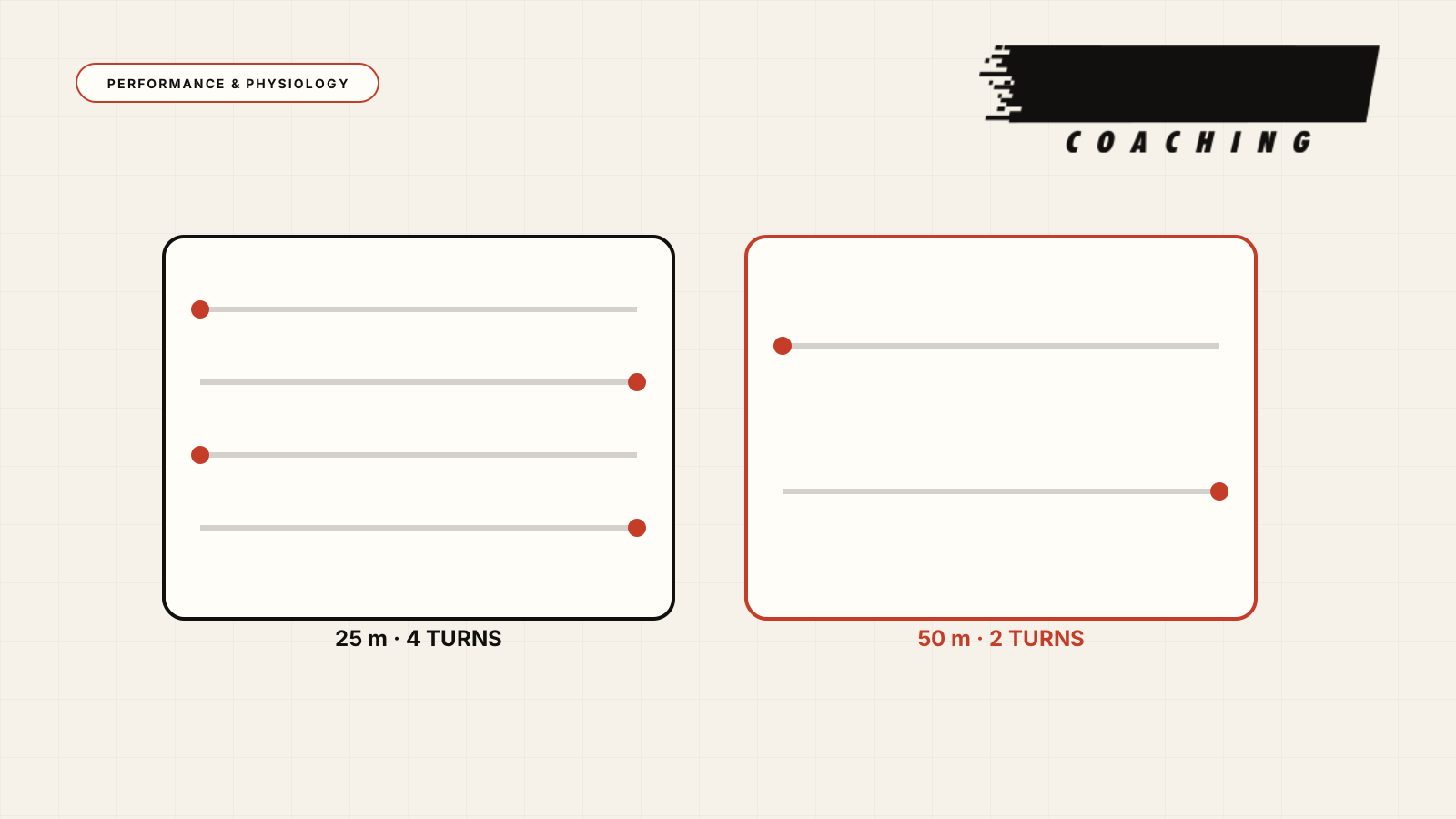
Distance is unchanged; the number of turns differs. Over 100 m, a 25 m pool has three turns, while a 50 m pool has one. The shorter pool gives two extra opportunities to gain speed from wall push-offs.
This does not mean every swimmer loses exactly 1.6 seconds per 100 m when moving from 25 m to 50 m. The actual difference depends on turn technique, stroke, distance, fatigue and speed retention after the wall. The calculator provides a practical estimate, not an official time equivalence.
Why we are usually faster in a 25 m pool
Each turn involves approaching the wall, changing direction, turning, maintaining an underwater streamline and returning to the surface. Done well, the push-off produces greater speed than you can sustain continuously with arms and legs alone.
A 25 m pool introduces more turns and shorter continuous-swimming sections. In a 50 m pool, you must maintain technique, body position and pace longer before the next wall push-off.
A large freestyle-results analysis found 25 m performances averaged around 2.0 ± 0.6% faster than 50 m performances. This is a useful average across many results, not a personal conversion factor.
A more recent laboratory study of eleven male swimmers examined 400 m freestyle efforts. At identical absolute speeds, energy cost was around 4% higher in the 50 m pool. This supports turns making short-course swimming more economical, but the small sample and specific protocol do not justify applying that percentage to every swimmer and session.
The difference varies between swimmers
The benefit of each additional turn depends on:
- approach speed and time lost at the wall,
- push-off force and direction,
- body position after pushing off,
- underwater and breakout quality,
- continuous swimming speed,
- fatigue and effort distance.
A strong swimmer may benefit more from every turn. A recreational athlete may approach slowly, linger at the wall or lose push-off speed quickly. Identical 25 m pool pace therefore need not produce identical 50 m pool pace.
Turn quality also changes within an effort. Fatigue can reduce approach speed, disrupt position or slow the breakout, so wall benefits are not constant. Elite race analyses show turns slowing as races progress, with faster swimmers generally executing them better and more consistently.
Stroke changes the conversion
Turns differ between strokes. Freestyle and backstroke generally use tumble turns; breaststroke and butterfly involve different wall contact and direction changes. The subsequent underwater phase also differs.
Research across ages and strokes found that short- versus long-course differences vary by stroke and age group. Larger differences appeared mainly in backstroke and breaststroke compared with butterfly and freestyle, especially over 100 and 200 m.
No single percentage therefore works equally well for all strokes and athletes.
How the Swim Course Converter calculates the difference
The tool does not apply a fixed percentage to time. It calculates the difference in turns per 100 m and multiplies it by an assumed benefit per extra turn:
time difference = difference in turns per 100 m × estimated benefit per turn
For the Club profile, the assumptions are:
Free: 0.8 seconds per extra turn,Back: 0.6 seconds,Breast: 1.0 second,Fly: 0.7 seconds,IM: 0.8 seconds.
Recreational uses half the turn benefit; Elite increases it by 50% relative to Club. These are this calculator’s assumptions, not official World Aquatics factors or personal measurements.
World Aquatics uses separate Short Course and Long Course reference bases for points tables. Do not present the converter’s result as an officially equivalent race time or use it without checking.
In the opening example, moving from 25 m to 50 m changes turns by two per 100 m. With Free, Club and 0.8 seconds per turn:
2 × 0.8 = 1.6 seconds/100m
Thus, 1:30/100m becomes an estimated 1:31.6/100m.
Which profile should you choose?
Recreational, Club and Elite do not describe overall fitness or competition category. They only describe how effectively the model assumes you use each wall.
- Choose
Recreationalfor slow turns, lost approach speed or difficulty maintaining position after push-off. - Choose
Clubfor consistent technique and effective push-offs and breakouts. - Choose
Eliteonly if turns and underwater work are genuine strengths.
Do not choose solely from your best time. A fast triathlete may have average turns, while a slower former competitive swimmer may use the wall much better.
How to use the calculator
- Under
From Pool, choose the pool length where your pace is known. - Under
To Pool, choose the target pool. - Under
Stroke, select your stroke. - Under
Level, choose the profile best describing turn ability. - Under
Pace, enter your pace in/100m.
Results show Estimated equivalent pace, total change per 100 m and assumed seconds per turn. The comparison table also estimates pace in 25 m, 50 m, 25 yd and 23 m pools.
Units remain /100m, including the 25 yd row. Use Custom for other lengths. Outside the usual 15–60 m range, uncertainty increases.
What changing pools means for CSS and training
A CSS test in a 25 m pool cannot be directly compared with a later 50 m pool test. Some difference may come from fewer turns, not changed fitness.
To track progress properly:
- repeat tests in the same pool with the same protocol,
- use the same start type,
- keep separate references for each pool length,
- assess technique, strokes per length and perceived effort alongside pace.
The converter can temporarily adjust targets when changing pools. It cannot replace consistently repeated testing under the same conditions.
If possible, swim the same controlled set in both pool lengths with similar fatigue and conditions. Your personal difference is more useful than any generic calculator assumption.
Conversion does not predict open-water pace
Converting 25 m to 50 m mainly addresses turn count. Open water has no walls and adds navigation, waves, currents, drafting, possible wetsuit use and deviations from the ideal line.
Even a correctly estimated 50 m pool pace therefore does not predict an open-water race or triathlon swim time.
Key takeaways
- Over 100 m, a 25 m pool has two more turns than a 50 m pool.
- Short-course pace is usually faster, but the difference varies.
- Turn quality, stroke, distance and fatigue affect the actual benefit.
- Level options and seconds per turn are calculator assumptions, not official conversion factors.
- For CSS tests and progress assessment, use the same pool, protocol and start type.
- Treat conversion as a practical training estimate, not official race-time equivalence.
Sources and further reading
- Wolfrum M, Knechtle B, Rüst CA, Rosemann T, Lepers R. The effects of course length on freestyle swimming speed in elite female and male swimmers — a comparison of swimmers at national and international level. SpringerPlus. 2013;2:643.
- Iglesias García J, Hermosilla-Perona F, Gonjo T, Juárez Santos-García D. Impact of course length on swimming performance across age groups and swimming strokes. Frontiers in Sports and Active Living. 2025;7:1631870.
- Bosetto P, et al. Swimming turns reduce energy demands of the aerobic performance in front crawl. European Journal of Applied Physiology. 2026;126(5):2491–2500.
- Cuenca-Fernández F, Ruiz-Navarro JJ, Polach M, Arellano R, Born DP. Turn Performance Variation in European Elite Short-Course Swimmers. International Journal of Environmental Research and Public Health. 2022;19(9):5033.
- World Aquatics. Swimming Points—separate Short Course and Long Course reference tables. ⏎