You have chosen your target time for Athens and written down your splits. But what will you do if the effort feels harder than expected in the first 10 km, or if you lose some of your gels? Those decisions need to be part of your plan before you reach the start line.
What your training can tell you about race-day decisions
Start with your training. At what intensity did you feel in control? How did the effort feel as time went on? What fuelling could you maintain without discomfort? These answers will help you decide what you can put into practice during your race. We have covered how to choose a realistic race pace in a separate article.
Let us use a hypothetical example: a runner whose training suggests that a finish time of around four hours is realistic for the Athens Marathon. They have repeatedly practised taking in 60 grams of carbohydrate per hour without problems, and they know what a controlled effort at around 5:40/km feels like during their long training runs.
In their recent long runs, however, they would forget to fuel in the final kilometres or when they started to tire. Their race plan therefore needs a recurring reminder on their watch.
Repeated practice with carbohydrate intake can also improve gastrointestinal tolerance, as a study in endurance runners showed (Costa et al., 2017). Stick with what you have consistently practised, and avoid changing products or quantities in the final days because you heard someone suggest something different.
How to read your splits alongside your effort
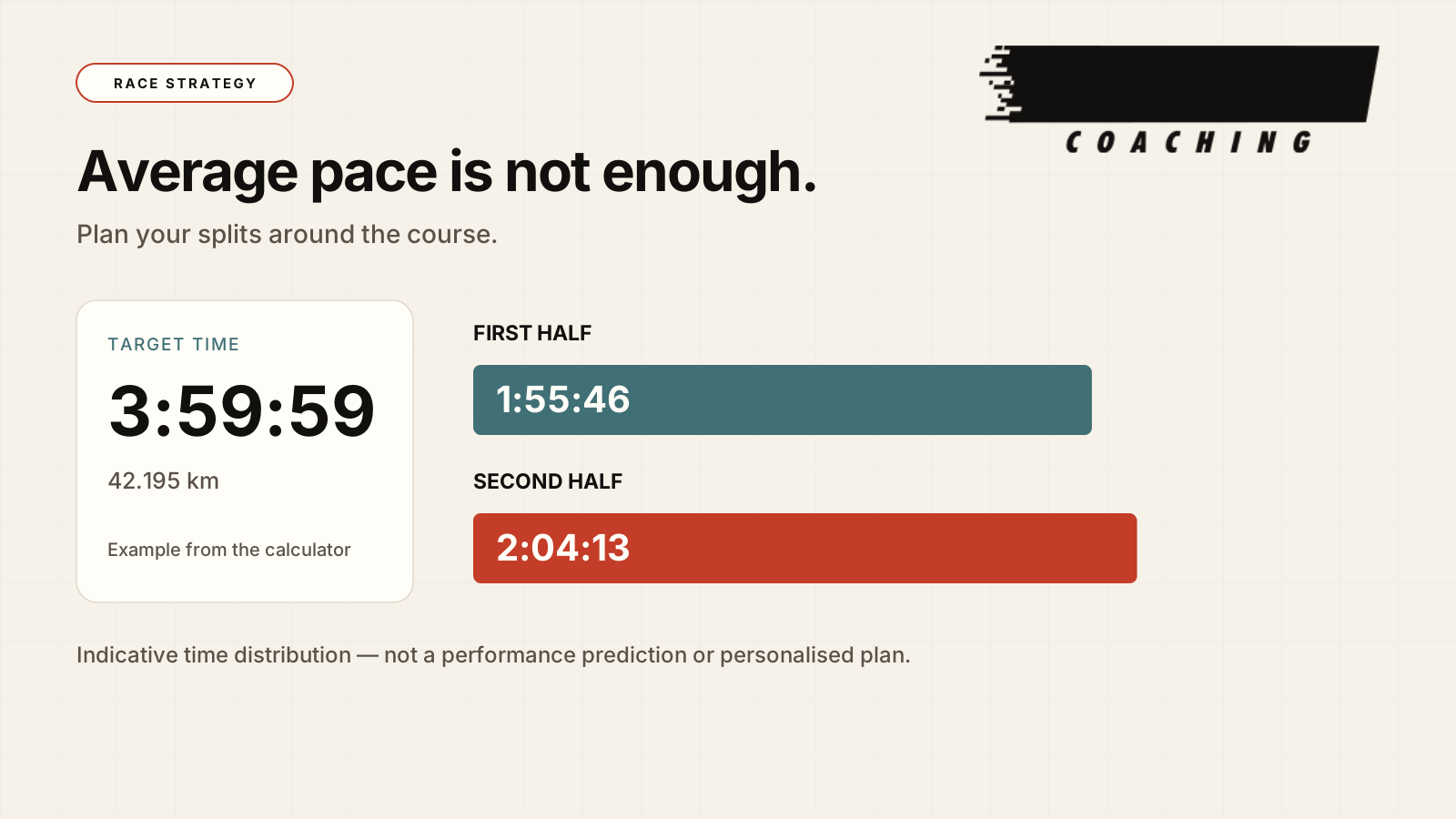
For the runner in our example, the Athens Marathon Splits Calculator can provide an initial picture of how their time might be distributed across the course. Those splits, however, need to be considered alongside the effort required to achieve them.
Choose a few checkpoints, such as 10 km, halfway and 30 km. At each one, check your time alongside your breathing, how your legs feel and your perceived effort. Also consider whether you have followed your fuelling plan. Hitting a split does not, on its own, tell you how much that effort has cost you, especially if you have missed some of your gels.
If our runner reaches 10 km close to their planned time but already feels under considerable strain, they need to ease off and reassess their target. There are still 32 kilometres to go, and persisting with an effort they cannot sustain will cost them later.
Similarly, a small delay caused by congestion does not need to be made up immediately. The Athens Marathon Splits Calculator is based on real race splits, but it does not separately calculate the delay caused by congestion in your own starting block. On the hills in Athens, allow your pace to change so that you can keep your effort under control. On the final, mainly downhill section after 31 km, whether you increase your pace depends on how you feel at that point.
Heart rate can add to this picture, provided you know from training how it behaves during similar efforts. An individual reading on your watch still needs to be considered alongside the gradient, the conditions and how you feel.
How to organise your fuelling and hydration
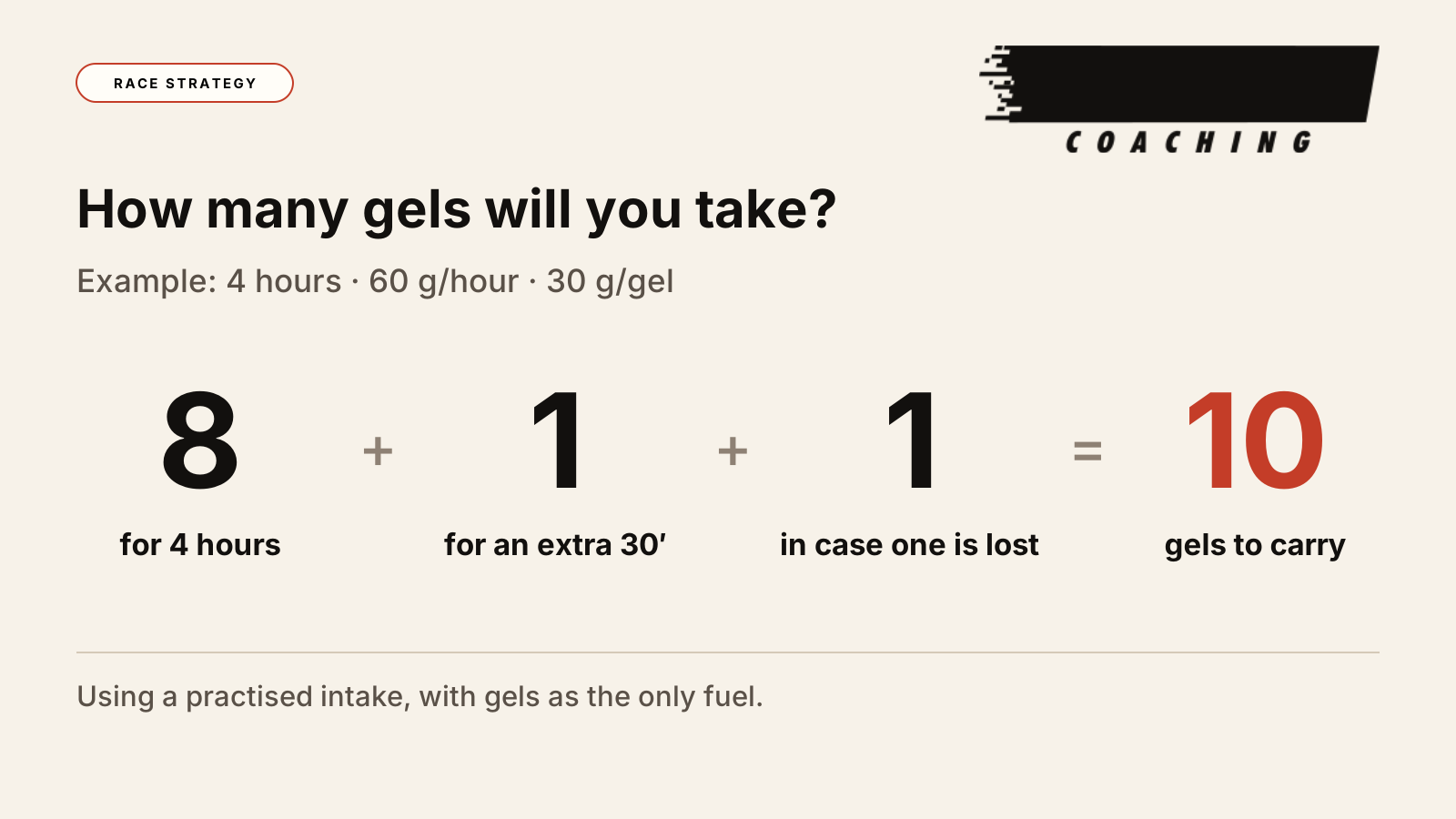
Four hours at 60 grams of carbohydrate per hour adds up to 240 grams in total. If each gel contains 30 grams and gels provide all of your race fuel, you will need eight gels. Your meal and anything you take before the start should be counted separately.
One example would be to take the first gel after 10 minutes and then one every 30 minutes, with the eighth gel at 3 hours and 40 minutes. This is an example of how to organise a carbohydrate intake you have already practised; your own schedule needs to suit the products you use and what you can tolerate. Factor in the water stations and adjust your gel timings slightly if that makes them easier to take.
If the race ends up taking four hours and thirty minutes, the same calculation gives 270 grams of carbohydrate. One extra gel covers that additional half-hour, and a second is kept in reserve in case you lose one on the course. To cover both possibilities, you therefore need ten gels in total. If you allow for a whole extra hour, you need two additional gels for that hour, as well as the spare for a possible loss. If you also drink sports drinks at the aid stations, include their carbohydrate content in your total. The Race Fueling Calculator helps you calculate the amount for your expected race duration.
Also check where the aid stations carrying the products you plan to use will be, and exactly what the organiser provides. If you intend to use products from the stations, you need to know them and to have tried them already. Bear in mind that some products may have run out by the time a slower runner reaches a particular station. You need to have planned for that, too.
Sweat rates vary considerably between athletes, so there is no single fluid intake that suits everyone (Sawka et al., 2007). Follow your tried-and-tested hydration plan, taking your thirst and the weather conditions into account, without forcing yourself to drink more than you need, but also without waiting until you feel thirsty to drink.
What to do if your plan needs to change
You need useful alternatives that connect a specific situation with a decision. “I will see how it goes” leaves that decision until you are already tired and probably not thinking clearly.
If the conditions are noticeably warmer than those you trained in, you should reassess your target time and start at a more conservative pace. Heat and humidity increase physiological strain and can reduce performance, particularly in long races (Racinais et al., 2015). Make that adjustment early, while you still have room to manage your race. A forecast of 23°C may not seem particularly hot if you did much of your training over the summer. But if high humidity and sunshine occur together, do not underestimate the conditions. Direct sunlight increases the heat load on your body, something the forecast air temperature alone does not describe. Combined with high humidity, the effort may feel harder than you expected.
In my research for the Athens Marathon Splits Calculator, I identified 4,082 potential runner matches between the 2024 and 2025 races. In 62.1% of cases, the runner was slower in 2025. The median change across all matches was +6:06. The National Observatory of Athens forecasts gave temperatures of 10–11°C near the start and 16–17°C towards the finish in 2024, with relative humidity of around 80–85% at the start and 45–50% in the finish area. For 2025, they forecast 17–19°C in the first half and 20–22°C in the second, with relative humidity of around 90% at the start and 70–75% in the finish area. The observed difference is indicative and consistent with the more challenging weather conditions in 2025, although it cannot be attributed solely to them. That is why your plan needs to adapt to the conditions on the day.
If you lose a gel, use the spare you brought for that situation. If you forget a scheduled carbohydrate intake, do not try to make up for it by taking twice as much at once. Make up the missed carbohydrate gradually, according to the amounts and frequency you have practised and can tolerate.
If you develop stomach discomfort, reduce your effort and reassess your intake. Continuing to push while mechanically consuming everything written in your plan will not solve the problem. Alternatives such as bananas or Coca-Cola from the aid stations may be an emergency option, provided you have tried them and can tolerate them.
Keep your alternatives few and specific: for your effort, your fuelling and the possibility of a longer race. You do not need to anticipate every eventuality. You do need an answer to the problems you already know from training that you may face.
How to keep your plan simple when you start to tire
You should still be able to remember the decisions you made before the race after three hours of running. A long sheet of split times and calculations can help during preparation, but during the race you will need a few clear notes that you can ideally remember without looking them up.
You can put your decisions into four lines:
-
Start: controlled effort, without getting drawn into a faster pace, with clear pace and heart-rate limits for the opening kilometres.
-
Checkpoints: 10 km, halfway and 30 km; time considered alongside perceived effort and heart rate.
-
Fuelling: your practised fuelling schedule, with watch reminders and your products within easy reach.
-
Adjustments: adapt to your effort and the conditions, with spare gels available.
Test your watch alerts beforehand so that you know they work for you while you are running.
Before finalising your race plan, read it again and picture yourself already in the race. Is it clear what you do at the start, when you check your effort and how you continue if something changes? If a note needs further explanation, make it more specific now.
What to take away
-
Base your decisions on what you have practised in training.
-
Assess each split alongside the effort it required.
-
Calculate and organise your fuelling for your expected duration, with a practical reserve.
-
Keep a few clear alternatives that you can use when you are tired.
References
-
Costa RJS et al. (2017). Gut-training. Applied Physiology, Nutrition, and Metabolism, 42:547–557.
-
Racinais S et al. (2015). Training and competing in the heat. Scand J Med Sci Sports, 25:6–19.
-
National Observatory of Athens / meteo.gr. Marathon course weather forecast for 2024.
-
National Observatory of Athens / meteo.gr. Marathon course weather forecast for 2025.