Suppose you run at 5:00/km on a steady 5% climb. The GAP Calculator estimates that this speed and gradient have a metabolic demand equivalent to around 3:55/km on flat ground.
Reversing the calculation to see how a flat-ground 5:00/km effort translates to a 5% climb gives an expected pace of around 7:06/km.
These are not personal physiological measurements or guarantees of your exact pace. They are estimates from a model that uses speed and gradient to calculate running’s energy cost.
What Grade-Adjusted Pace is
Grade-Adjusted Pace (GAP) attempts to answer one specific question:
What flat-ground pace has approximately the same metabolic demand as a given uphill or downhill pace?
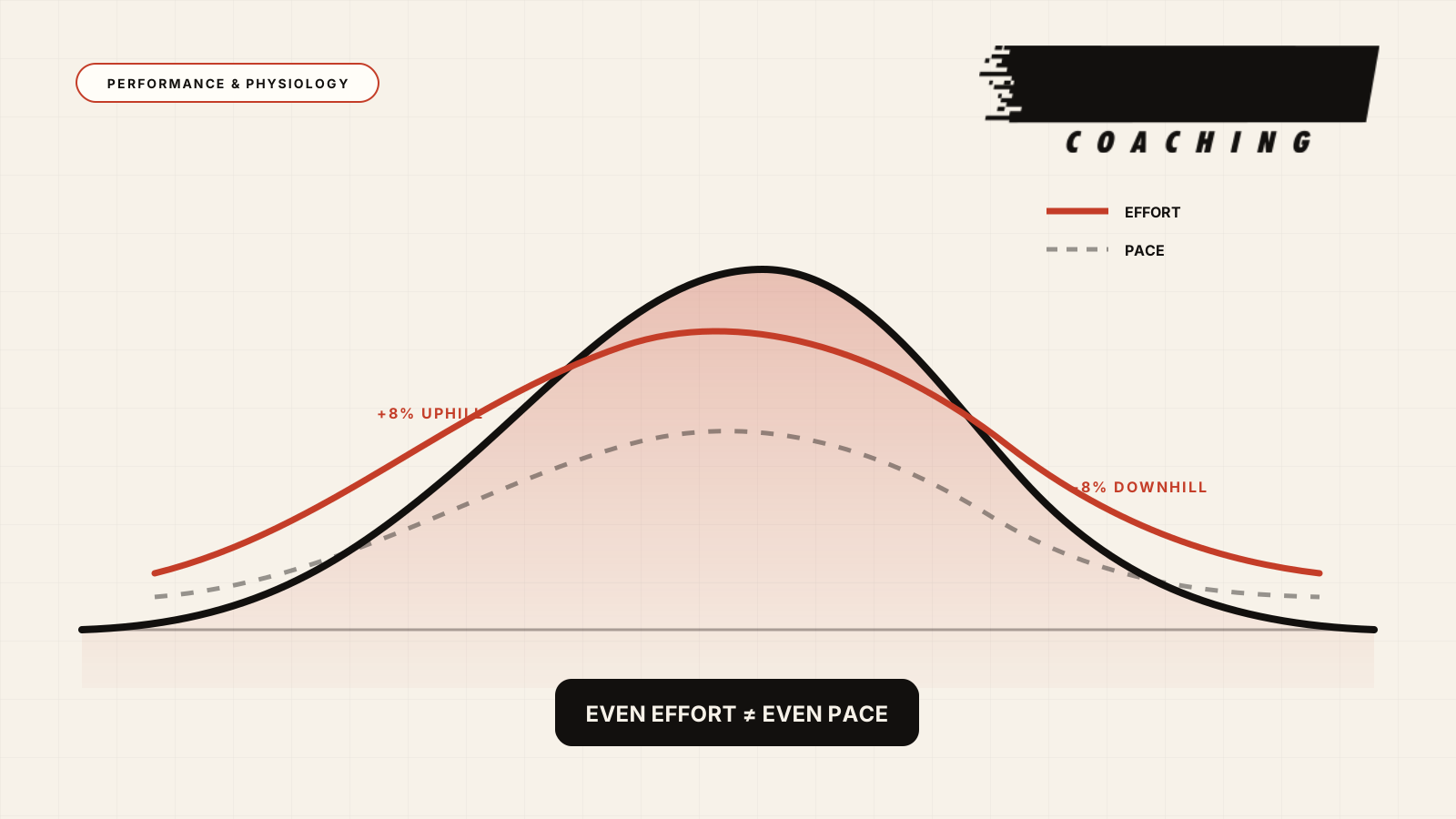
Uphill, GAP is usually faster than the actual pace on your watch. Downhill, it is usually slower. This lets you compare sections where actual pace differs greatly because of gradient.
“Equivalent” needs care. GAP primarily estimates metabolic demand using a general model. It does not mean muscular load, technical difficulty, grip or fatigue match flat-ground running.
GAP is therefore not the “true flat pace” you could definitely run. It is a way to include gradient’s effect when analysing effort.
What a 5% gradient means
Gradient expresses elevation change relative to horizontal distance:
Gradient (%) = (elevation change / horizontal distance) × 100
A 5% climb gains 5 m of elevation for every 100 m travelled horizontally. Similarly, 100 m of ascent over 1 km horizontally corresponds to a 10% gradient.
Gradient is not the same as slope angle in degrees. A 10% gradient, for example, corresponds to approximately 5.7°.
Why running uphill costs more
On flat ground, you mainly move your body forwards. Uphill, you must also raise your centre of mass, performing more positive mechanical work against gravity.
At the same speed, this generally means greater oxygen consumption, cardiovascular strain, shorter strides and longer ground-contact time.
Gradient and energy cost are not linearly related. You cannot add a fixed number of seconds per kilometre for each additional 1% uphill and expect accurate results across all speeds and gradients.
Downhill is not the opposite of uphill
Downhill, gravity helps you move faster and immediate metabolic cost can decrease. Your muscles, however, must absorb more energy and control movement through eccentric contractions, particularly in the quadriceps.
This increases braking and stabilisation demands, impact forces and local muscular and neuromuscular load. It can also affect running economy later in the race or over the following days.
A descent’s energy “discount” is therefore not unlimited. On gentle, smooth descents, you can usually increase speed at lower metabolic cost. As the descent becomes steeper or more technical, braking, safety and speed-control ability limit the actual benefit.
A metabolically easy-looking GAP can therefore accompany substantial muscular load. The calculator cannot predict its cost to your legs after many kilometres.
How the GAP Calculator works
The calculator works in two directions:
Hill pace → Flat effort
Use this when you know your actual uphill or downhill pace and want to calculate FLAT-GROUND GAP.
In the opening example:
HILL PACE: 5:00/km,GRADE: +5%,FLAT-GROUND GAP: around 3:55/km.
Flat effort → Hill pace
Use this when starting from a flat-ground reference pace to estimate EXPECTED HILL PACE at the same theoretical metabolic effort.
For example:
FLAT-GROUND EFFORT: 5:00/km,GRADE: +5%,EXPECTED HILL PACE: around 7:06/km.
Under HILL, enter Grade % or choose Rise / Run. With the latter, select Uphill or Downhill, then enter elevation change and horizontal distance.
The calculator uses an additive metabolic-cost model. The flat-ground speed effect comes from Black et al., while gradient’s additional cost uses the Minetti et al. model. Results are rounded to the nearest second.
Because energy cost is expressed per kilogram of body mass, no weight input is needed. Running economy, strength, technique and familiarity with gradients still differ between athletes.
Where GAP accuracy is limited
The Minetti et al. gradient model was based on treadmill tests in ten high-level male runners experienced in mountain running. The result is therefore a population-based estimate, not your personal adjustment factor.
Uncertainty grows when factors outside the model are added:
- technical or uneven terrain,
- mud, sand, gravel or poor grip,
- many turns and frequent pace changes,
- altitude, heat and wind,
- fatigue from earlier climbs or descents,
- carried load,
- switching from running to power hiking.
In a study of 12 runners, even small surface irregularities on a specially adapted treadmill increased energy expenditure by around 5% compared with a smooth surface. This was a specific laboratory finding, not a 5% correction to apply to every trail run.
On very steep climbs, brisk walking can be more economical than running. The exact transition depends on gradient, speed, athlete and terrain. Once movement changes, a running-only model loses some applicability and reliability.
Your watch’s instantaneous GAP can mislead
GAP needs accurate speed and gradient data. A GPS or elevation error over a short section can cause a large deviation. Whole-session average gradient is also insufficient: a route climbing 100 m and then descending 100 m does not cost the same as a flat route.
For more useful analysis:
- divide the course into relatively uniform sections,
- use longer segments rather than instantaneous readings,
- check elevation data against the course profile,
- combine GAP with RPE, breathing and heart rate.
How to use GAP in training
Use GAP as an additional layer of analysis to:
- compare similar sessions on courses with different gradients,
- assess repetition consistency on the same hill,
- avoid overpacing when actual uphill pace looks slow,
- identify sections where GAP, RPE and breathing disagree,
- plan approximate pace for particular race sections.
For repetitions on the same hill, actual pace, repetition time and RPE remain more reliable, direct measures. Add GAP to the analysis without replacing the other data.
GAP and race planning
In a road race with gentle, steady gradients, GAP can help you avoid trying to hold identical actual pace every kilometre. Slow down uphill to control intensity, then progressively return towards your target downhill without immediately trying to recover all lost time.
GAP has even less practical applicability in trail racing. Technical terrain, duration, fuelling, descending ability and switching to power hiking or walking can influence speed more than average gradient.
Do not set one GAP target for the entire course. Divide it into sections and define an acceptable effort range with clear reassessment points. The calculator provides an initial estimate; your preparation and race-day condition determine whether you can apply it.
Key takeaways
- GAP estimates flat-equivalent pace from speed and gradient.
- It primarily expresses metabolic equivalence, not equal muscular or technical load.
- Uphill and downhill costs are not symmetrical.
- The calculator works as
Hill pace → Flat effortand in reverse asFlat effort → Hill pace. - It is based on smooth treadmill running and does not automatically adjust for technical trails, wind, heat, altitude or fatigue.
- Use longer segments, not your watch’s instantaneous GAP.
- Combine GAP with RPE, breathing, heart rate and experience on similar gradients.
Use the GAP Calculator to convert uphill or downhill pace into estimated flat-ground effort, or estimate pace on a given gradient. If temperature also affects your session or race, assess it separately with the Heat-Adjusted Pace Calculator.
Sources and further reading
- Minetti AE et al. Energy cost of walking and running at extreme uphill and downhill slopes. Journal of Applied Physiology. 2002.
- Black MI et al. Is There an Optimal Speed for Economical Running? International Journal of Sports Physiology and Performance. 2018.
- Voloshina AS, Ferris DP. Biomechanics and energetics of running on uneven terrain. Journal of Experimental Biology. 2015.
- Giovanelli N et al. Energetics of vertical kilometer foot races; is steeper cheaper? Journal of Applied Physiology. 2016.
- Baumann CW et al. Muscle injury after low-intensity downhill running reduces running economy. Journal of Strength and Conditioning Research. 2014.