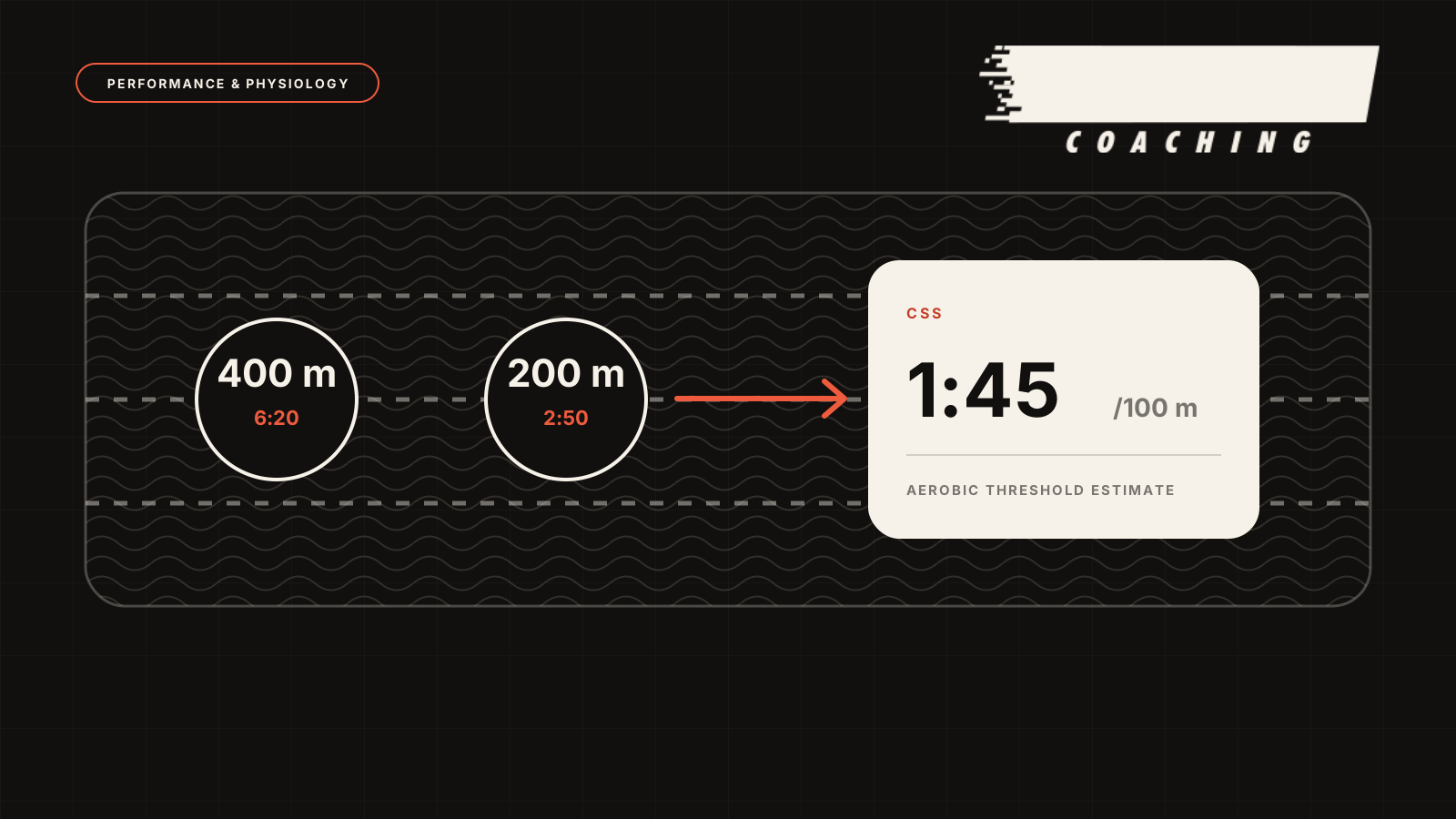
Suppose you swam 200 m in 2:50 and 400 m in 6:20. Entering these times in the Critical Swim Speed Calculator gives a CSS of 1:45/100 m and D′ of around 38.1 m.
The 1:45/100 m is not the average of the two efforts. It comes from the mathematical relationship between distance and time. It provides a practical reference pace for upper-aerobic training and threshold sets, but is certainly not a laboratory measurement of lactate threshold or a pace you can sustain indefinitely.
A useful result requires two well-executed efforts, a consistent protocol and an understanding of the model’s limits. A pacing mistake in the 200 m or 400 m can directly change the CSS you use in subsequent sessions.
What Critical Swim Speed is
Critical Swim Speed (CSS) applies the Critical Speed model to swimming. The model describes the relationship between distance covered and the duration of a maximal effort:
Distance = CSS × Time + D′
The two parameters are:
- CSS: the speed represented by the slope of the distance–time relationship.
- D′ (D prime): the intercept of that relationship on the distance axis. Mathematically, it describes the finite additional distance you can cover above CSS.
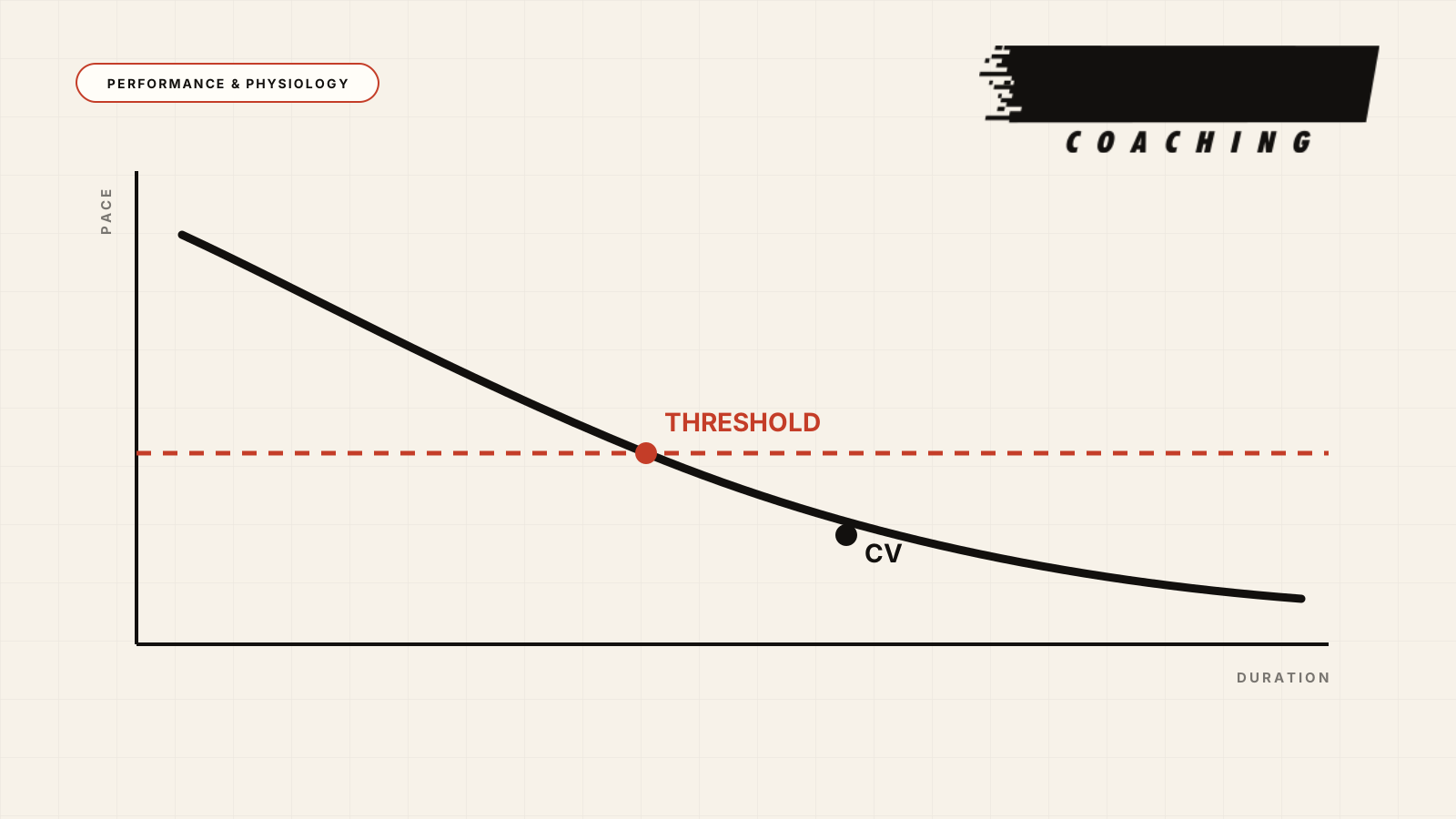
In exercise physiology, Critical Speed is used to estimate the boundary between the heavy and severe intensity domains. Above this boundary, physiological strain cannot stabilise in the same way, and the effort eventually ends in exhaustion.
The calculator does not measure oxygen consumption, lactate or your metabolic response. It calculates model parameters from two times you enter. CSS is therefore a field-test estimate, not a personal laboratory assessment of your physiology.
How CSS is calculated
With two maximal efforts over different distances, the calculation is:
CSS = (D₂ − D₁) / (T₂ − T₁)
In our example:
- 200 m in 2:50 = 170 seconds,
- 400 m in 6:20 = 380 seconds,
- CSS =
(400 − 200) / (380 − 170), - CSS =
200 / 210 = 0.952 m/s.
To convert speed into pace per 100 m:
100 / 0.952 = 105 seconds = 1:45/100 m
D′ is calculated using:
D′ = Distance − CSS × Time
Using either effort gives a result of approximately 38.1 m.
D′ is not a literal tank that empties and refills in a perfectly predictable way. In a study of national-level swimmers, CSS from 200 and 400 m efforts had a coefficient of variation below 4%, while D′ variability ranged from 13% to 45%. CSS can therefore serve as a main reference, whereas D′ needs much more cautious interpretation and is not a training target in itself.
CSS and lactate threshold are not the same
CSS is often called “swim threshold pace”. This is a useful coaching simplification, but not a precise physiological definition.
A study of the 200 and 400 m protocol in eight swimmers found a strong correlation between CSS and speed at 4 mmol/L lactate, with lactate concentration stabilising near 100% of CSS. A later study in eight well-trained swimmers found CSS to be higher on average than speed at Maximal Lactate Steady State (MLSS), with individual differences large enough to prevent treating the values as identical.
This does not make CSS less useful. It means you should treat it as a practical reference near high aerobic intensity, rather than a direct measurement of your lactate threshold.
If a continuous swim at CSS proves unsustainable, it does not necessarily mean you failed. Time to exhaustion at Critical Speed varies considerably between individuals, and the result also depends on the estimation protocol.
How to perform the test correctly
The calculator offers two PROTOCOL options:
200 + 400 RECOMMENDED400 + 800
The 200 + 400 m protocol is the most practical for most swimmers and triathletes. The 400 + 800 m protocol reduces the relative influence of the shorter, faster effort, but requires better pacing and produces more fatigue. Results from the two protocols should not be compared as if they came from the same test.
For the recommended 200 + 400 m protocol:
- Complete a thorough, repeatable warm-up.
- Swim the 400 m first, aiming for your fastest overall time with a controlled start and pacing as even as possible.
- Take 10–15 minutes of easy recovery.
- Swim the 200 m as your second maximal effort.
- Record the total time for both efforts.
A maximal effort does not mean sprinting the first 25 or 50 m. It means the fastest overall time you can achieve over the full distance. Starting too fast and losing pace in the second half will also affect the calculation.
To compare future tests, keep the following consistent:
- the same pool and course length,
- the same stroke,
- the same type of start,
- similar warm-up and effort order,
- the same aids—preferably no paddles, fins or pull buoy,
- similar fatigue levels and time of day.
A result from a 25 m pool cannot be compared directly with one from a 50 m pool, because the number of turns and wall push-offs changes.
How to use CSS in training
CSS is most useful as a consistent reference for high-aerobic-intensity sets. It can be used in sessions such as:
10×100 m,5×200 m,3×400 m,
with recovery, total volume and pace adjusted to the session’s purpose and your level.
The same CSS does not always produce the same training stimulus. 10×100 m with short recovery has a different cost from a continuous 1000 m, even at the same overall pace. Breaks allow partial recovery, helping you accumulate more volume near CSS while maintaining better technique. D′ recovery, however, varies considerably and cannot be calculated precisely with a simple stopwatch.
If your CSS is 1:45/100 m, a small practical range around it—for example, 1:44–1:46/100 m—is usually more useful than chasing an exact second on every 100 m. The final range depends on the set and the test’s potential error.
Alongside your splits, assess:
- RPE and breathing,
- stroke count and stroke rate,
- whether you maintain distance per stroke,
- turn and streamline quality,
- any pace drop in the final repetitions.
If you hit the times but your technique collapses, the set may have lost its training purpose. A calculator output is not a workout in itself.
Pool CSS is not automatically your open-water race pace
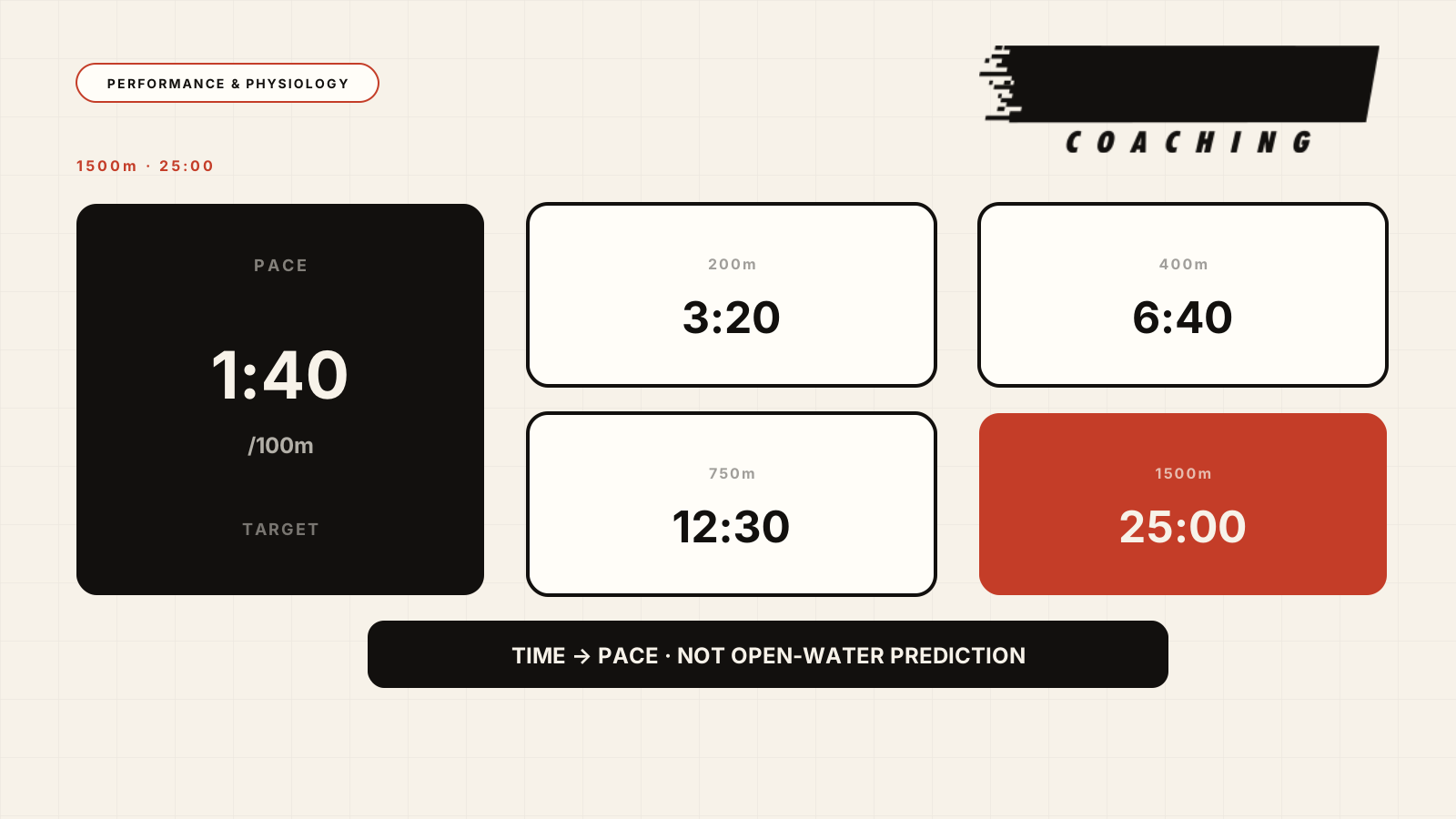
The theoretical 25:35 for 1500 m shown by the calculator in our example extrapolates the same mathematical relationship. It does not predict that you will swim 1500 m in 25:35, particularly in a triathlon.
Open water has no turns or wall push-offs. Instead, it introduces sighting, waves, currents, contact with other athletes, drafting, wetsuits and the possibility of swimming a longer actual distance.
Use CSS to organise pool training. Establishing race pace requires race-specific sets and open-water sessions to assess technique, navigation and an intensity that allows you to bike and run well afterwards.
When to repeat the test
There is no need to test CSS every week. Repeat it at the end of a relevant training block, usually after 6–8 weeks, or following a meaningful change in fitness or technique.
Do not assess only the final CSS. Look separately at the 200 and 400 m times, pacing, RPE and technique. A very small pace improvement may fall within normal test variability, while a better-controlled effort with unchanged CSS can indicate real training progress.
Key takeaways
- CSS is a mathematical estimate from two maximal efforts, not a laboratory measurement.
- The 200 + 400 m protocol is practical, provided both efforts are well executed.
- CSS and MLSS are related, but are not the same measurement.
- D′ is a highly variable model parameter, not an absolute training target.
- Use CSS alongside recovery, RPE and technique to organise threshold sets.
- Do not compare tests performed with different protocols, pool lengths or start types.
- Pool CSS does not transfer directly to open-water race pace.
Use the Critical Swim Speed Calculator to calculate CSS and D′ from either the 200 + 400 m or 400 + 800 m protocol. To convert a total time into splits per 100 m, use the Swim Pace Calculator.
Sources and further reading
- Wakayoshi K et al. Does critical swimming velocity represent exercise intensity at maximal lactate steady state? European Journal of Applied Physiology and Occupational Physiology. 1993.
- Dekerle J et al. Critical swimming speed does not represent the speed at maximal lactate steady state. International Journal of Sports Medicine. 2005.
- Scott BE, Burden R, Dekerle J. Stroke-Specific Swimming Critical Speed Testing: Balancing Feasibility and Scientific Rigour. Journal of Human Kinetics. 2024.
- Raimundo JAG et al. Modeling the expenditure and reconstitution of distance above critical speed during two swimming interval training sessions. Frontiers in Physiology. 2022.
- Nikitakis IS et al. Physiological Responses of Continuous and Intermittent Swimming at Critical Speed and Maximum Lactate Steady State in Children and Adolescent Swimmers. Sports. 2019.