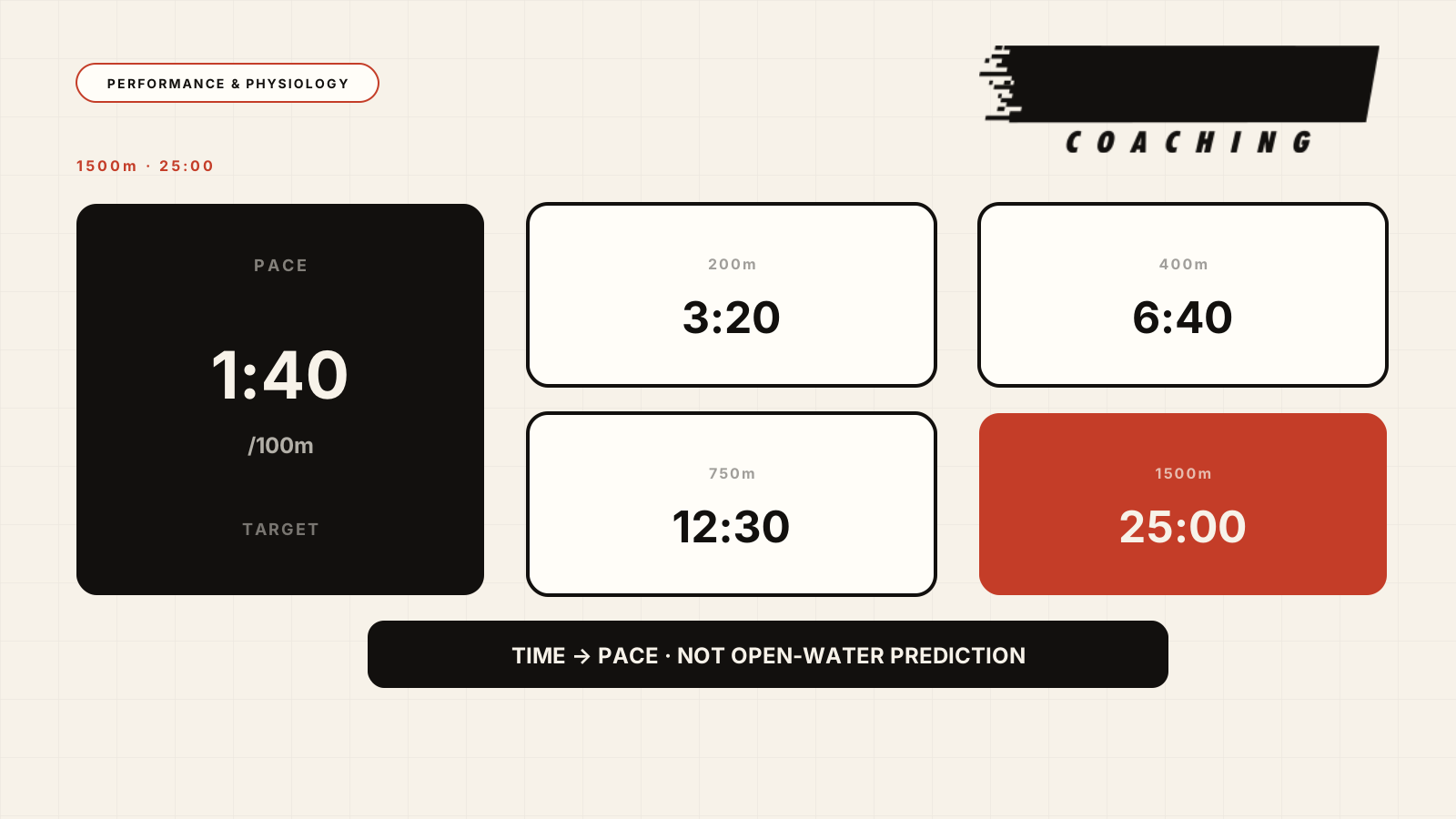
Suppose you want to swim 1500 m in 25 minutes. You need an average pace of 1:40/100 m. That means splits of 1:40 at 100 m, 3:20 at 200 m, 6:40 at 400 m and 12:30 at 750 m.
The conversion is mathematically exact. It does not prove that you can sustain that pace continuously, or that your finishing time will be the same in a 25 m pool, a 50 m pool or open water.
The Swim Pace Calculator answers a specific question: what pace per 100 m corresponds to a total time, or what total time corresponds to a given pace. Assessing whether the target is realistic requires recent training data, sound technique and conditions similar to those in which you will swim.
From total time to pace per 100 m
The basic calculation is:
pace/100 m = total time × (100 / distance)
For 1500 m in 25:00, first convert the time to seconds:
25 × 60 = 1500 seconds
Then:
1500 × (100 / 1500) = 100 seconds/100 m = 1:40/100 m
The reverse calculation is just as simple. If you know you can sustain 1:40/100 m, 1500 m requires fifteen 100 m segments:
1:40 × 15 = 25:00
You do not need to do these calculations by hand. The calculator can convert accurately, but you should understand what it cannot predict.
Turn pace into splits at chosen distances
At a steady 1:40/100 m, the main splits are:
| Distance | Time |
|---|---|
| 50 m | 0:50 |
| 100 m | 1:40 |
| 200 m | 3:20 |
| 400 m | 6:40 |
| 750 m | 12:30 |
| 1500 m | 25:00 |
Longer splits are more useful in practice than mechanically checking every lap in the pool. If your first 400 m takes 6:20 instead of 6:40, you have not simply “gained” 20 seconds. You have started at a different intensity, which can quickly increase fatigue and affect your technique in the second half.
This does not mean every 100 m must be exactly 1:40. The start, turns, other swimmers in your lane and small changes in technique create normal minor variations. Use two or three checkpoints and assess whether your average pace, breathing and technique remain controlled.
The same pace does not mean the same session
A pace of 1:40/100 m describes how fast you move through the water. It does not describe the training stimulus.
For example:
15×100 min 1:40 with 20″ rest,3×500 min 8:20 with short recovery,1500 mcontinuously in 25:00
are not the same workout. Recovery duration changes the accumulation of fatigue, the internal load and your ability to maintain sound technique for an extended period.
The target for each set should follow the session’s purpose: aerobic endurance, CSS/threshold, race pace or maintaining technique as fatigue builds. The number the calculator gives you is not a workout in itself.
To assess execution properly, consider together:
- split consistency,
- RPE and breathing control,
- stroke count per lap and stroke rate,
- turn and streamline quality,
- your ability to maintain technique in the final repetitions.
If you hit the time by continually increasing stroke rate while distance per stroke falls—meaning more strokes per lap—the target time may be right, but the execution is drifting away from the session’s primary purpose.
A 25 m and a 50 m pool do not produce the same pace
A pace of 1:40/100 m in a 25 m pool does not automatically transfer to a 50 m pool. Over the same total distance, a 25 m pool involves more turns, more wall push-offs and more total time underwater.
In a large analysis of freestyle results from 50 to 1500 m, national- and international-level swimmers were around 2% faster on average in a 25 m pool. This is an overall finding for the swimmers in that analysis, not your personal conversion factor between 25 m and 50 m pace. Your own difference depends on turn quality, streamline, underwater work and swimming style.
When changing pool length, use the Swim Course Converter as an initial estimate and check the result against your own splits in comparable conditions.
Pool pace is only a starting point for open water
Open water has no walls or turns. Other factors come into play:
- navigation and sighting,
- waves and currents,
- contact with other athletes,
- drafting,
- wetsuit use,
- extra distance from swimming off course.
In a controlled test of seven trained swimmers, drafting at the same speed reduced oxygen consumption, heart rate, lactate and RPE. This suggests that positioning yourself correctly behind another swimmer can reduce energy cost. It does not mean every position within a group offers the same benefit or compensates for poor navigation.
In our example, 1:40/100 m equals a speed of 1 m/s. If you actually swim 1580 m instead of 1500 m, the extra 80 m adds 1:20 to your time, even if you maintain exactly the same speed.
A recent study in elite triathletes found a close relationship between 1500 m performance in a pool and in open water, but also different swimming technique in the two environments. Pool pace is therefore a useful reference point, rather than a guarantee of your open-water race time.
In triathlon, consider the energy cost of the swim too
In triathlon, your fastest possible standalone swim split is not automatically the best race plan. Swim intensity should allow you to leave the water in control and continue into the bike and run that follow.
Before committing to a target such as 25:00 for 1500 m, check whether:
- it is supported by a recent pool test or race-specific set,
- you can approach it while maintaining sound technique and sighting,
- it has been tested in open-water conditions,
- it allows you to finish the swim with controlled breathing and an acceptable RPE.
Otherwise, the time remains a desired target rather than a realistic race pace. The calculator can convert it correctly, but it cannot validate it.
How to use the Swim Pace Calculator
The tool works in two directions:
- Select
Time → Pacewhen you know the distance and target time and want the required pace per 100 m. - Select
Pace → Timewhen you know the pace you can sustain and want the corresponding total time. - Under
Course, choosePool,Open WaterorCustom, then the distance you need. - Use the result to create two or three useful splits for your training session or race.
Selecting Open Water changes the calculation distance. It does not automatically adjust time for waves, currents, sighting, drafting or a wetsuit. Likewise, Pool does not automatically convert pace between 25 m and 50 m pools.
Key takeaways
- Time and distance convert accurately into average pace per 100 m.
- The result does not predict whether you can sustain that pace or determine training intensity by itself.
- Use longer checkpoints rather than checking your pace every 25, 50 or 100 m.
- Recovery, RPE and technique completely change the meaning of a session or set at the same pace.
- Pace from a 25 m pool does not transfer unchanged to a 50 m pool or open water.
- In triathlon, your swim target should account for the bike and run that follow.
Use the Swim Pace Calculator to convert your target time into pace per 100 m, or calculate the total time corresponding to a pace you can sustain.
Sources and further reading
- Polach M, Thiel D, Kreník J, Born DP. Swimming turn performance: the distinguishing factor in 1500 m world championship freestyle races? BMC Research Notes. 2021.
- Wolfrum M, Knechtle B, Rüst CA, Rosemann T, Lepers R. The effects of course length on freestyle swimming speed in elite female and male swimmers. SpringerPlus. 2013.
- Bassett DR Jr, Flohr J, Duey WJ, Howley ET, Pein RL. Metabolic responses to drafting during front crawl swimming. Medicine & Science in Sports & Exercise. 1991.
- López-Belmonte Ó et al. Swimming Performance in Elite Triathletes: Comparison Between Open Water and Pool Conditions. Scandinavian Journal of Medicine & Science in Sports. 2024.