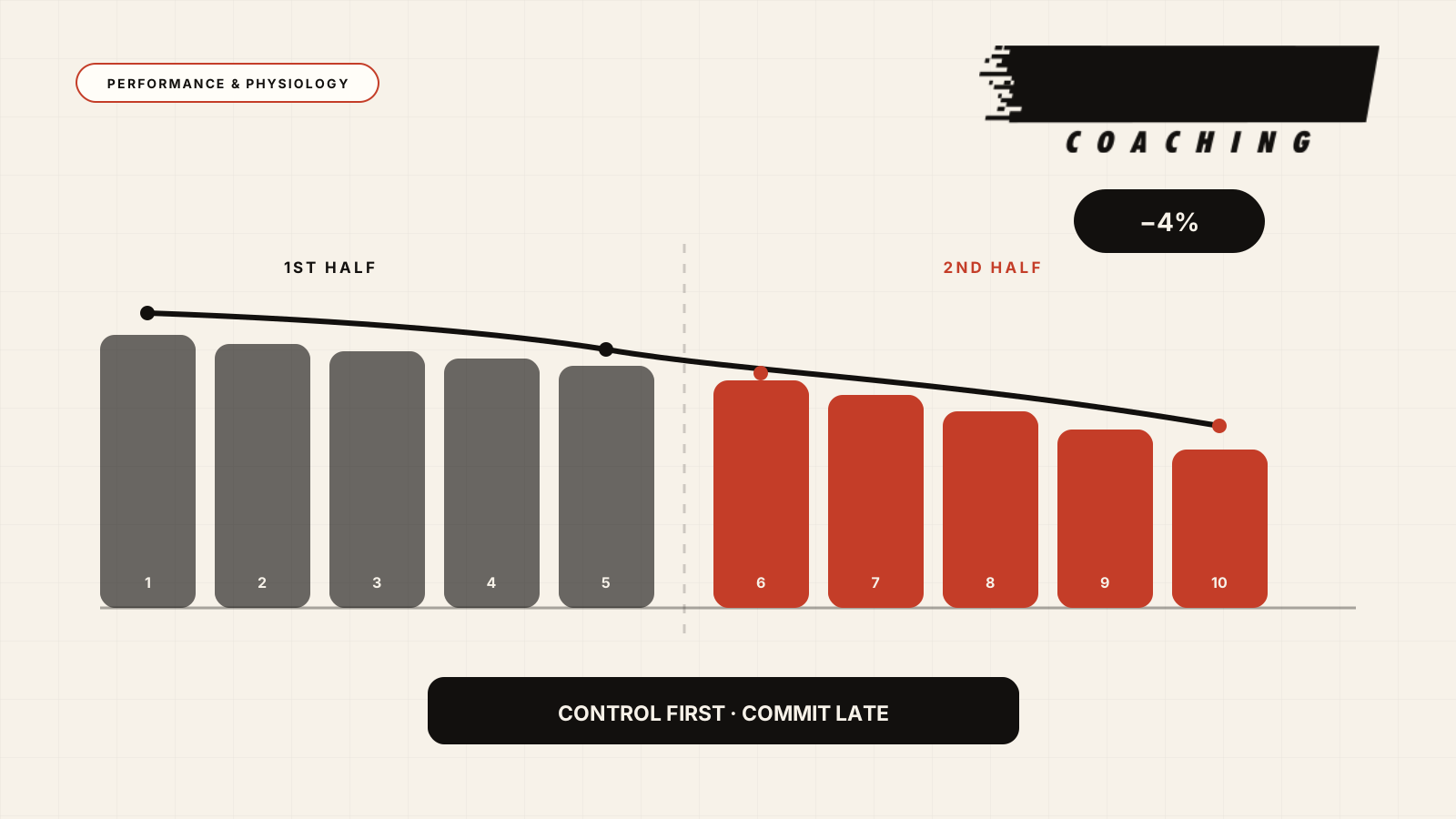
Suppose you want to run 10K in 40 minutes. Even pacing requires 4:00/km. With a mild negative split, you might start slightly slower, gradually approach average pace and finish the final kilometres slightly faster.
This strategy’s main advantage is protection against an overenthusiastic start when you feel fresh. But starting slower does not always produce a better race. Give away too much time in the first half and you may lack the distance or capacity to recover it.
A negative split is one possible outcome of well-distributed effort, not an end in itself or a guarantee of better performance.
What a negative split is
Running races commonly show three broad pacing patterns:
- Even split: both halves take approximately the same time.
- Positive split: the second half is slower.
- Negative split: the second half is faster.
Running the first 5 km of a 10K in 20:20 and the second in 19:40 gives a 40-second negative split. Your finish time is 40:00, just as it would be with both 5 km halves in 20:00.
The difference lies in effort distribution. The first scenario requires progressive acceleration; the second aims for a pace as steady as possible. Both can work if the target is realistic and execution fits the course, weather and preparation.
Starting too fast is usually the greatest risk
In a race’s opening minutes, fresh legs and adrenaline can make pace feel easier than it really is. Start substantially faster than a sustainable intensity and the cost does not disappear. It carries into the second half, when body temperature, muscular fatigue and energy cost have already risen.
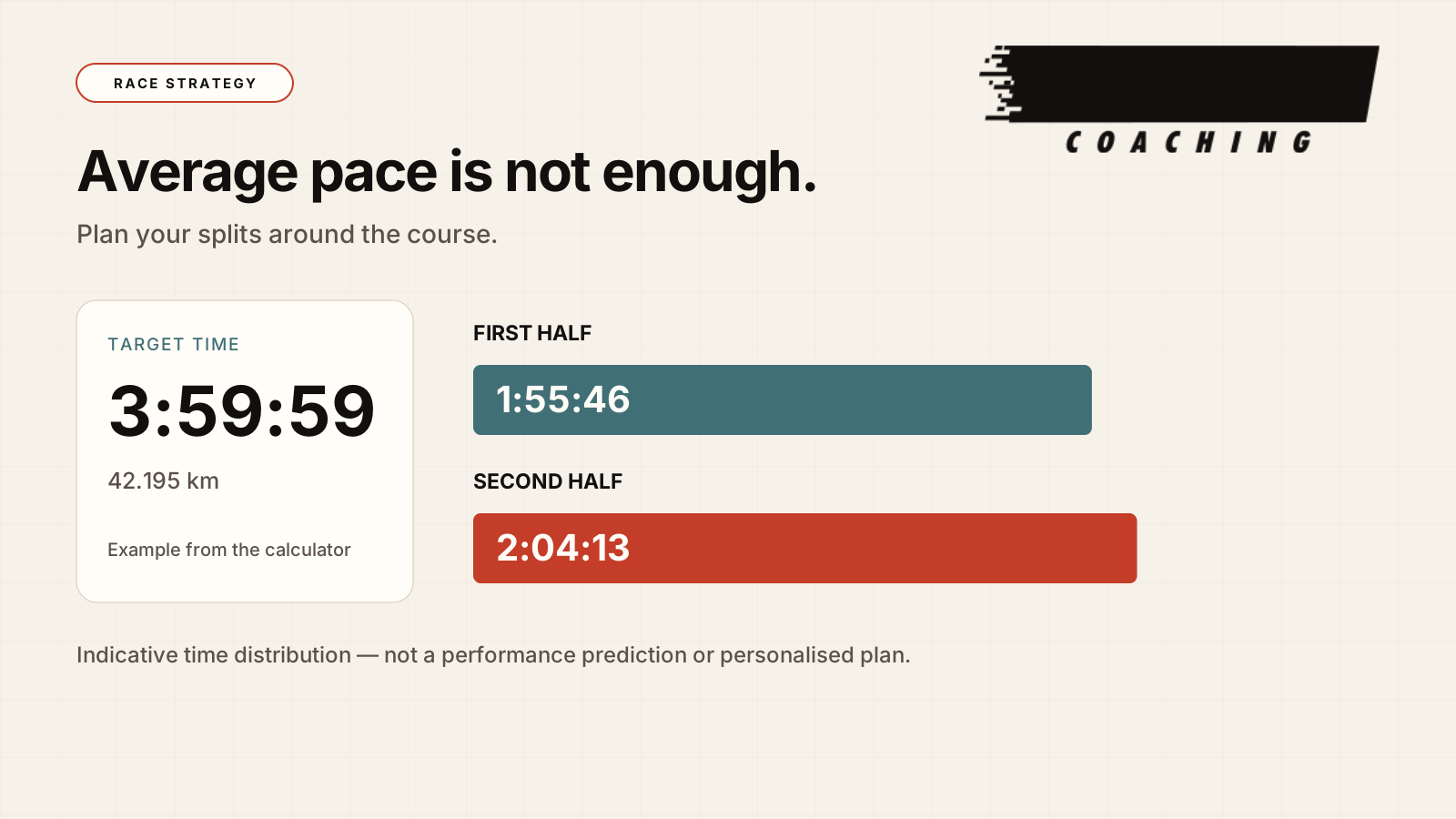
The result is often a large positive split: slowing because you can no longer sustain the opening pace, not because you planned it.
An analysis of more than four million marathon results found marked, sustained late-race slowing in 28% of men and 17% of women. This was more than normal end-of-marathon fatigue; it was a substantial pace collapse.
A controlled opening does not eliminate the risk, but gives you more time to assess breathing, RPE, fuelling and your body’s response before committing to greater intensity.
An overly conservative start is not necessarily good pacing
The opposite mistake is treating a negative split as proof of good strategy. If you were capable of 40:00 for 10K but started too slowly and finished in 41:00 with very fast final 1–2 kilometres, an “aggressive” negative split does not mean you used your ability well.
The useful question is not “how aggressive or conservative was my negative split?” but “did I distribute effort to achieve the best realistic result for my ability that day?”
On a flat course in steady conditions, the safest starting point is usually a controlled pace near target with a small margin for progressive acceleration. Longer distances require greater restraint early on, but you need not give away minutes waiting for the second half.
Even pace does not always mean even effort
The same pace has different costs around a course. Uphill, in heat or into a headwind, holding target pace requires more effort. Downhill or with a tailwind, the opposite may happen.
Assess a negative split alongside the course profile. If the first half has more climbing and the second is easier, a faster second half can naturally result from relatively steady effort. If the second half is harder, a slightly slower time does not necessarily mean you failed to execute your planned negative split.
In these situations, use pace alongside:
- perceived exertion (RPE),
- breathing,
- heart rate as a supplementary indicator,
- elevation, wind and temperature,
- the overall split pattern rather than one kilometre.
Strategy changes with distance
No single negative-split percentage suits every race and athlete.
5K
In a 5K, there is little room for an excessively slow start. A study in 11 moderately trained women found that an opening section 3–6% faster than average pace could be tolerated without a statistically significant finish-time difference. The sample and conditions do not support a universal rule. They do show that optimal 5K pacing need not involve a slow start aimed at an aggressive negative split.
10K
In a simulated 10K, faster athletes started quickly over the first 400 m, settled for most of the race and accelerated again at the end. Slower athletes did not show the same pattern. Your level and characteristics therefore influence the strategy you can execute.
For most recreational runners, the practical priority is to avoid getting carried away at the start, settle promptly into controlled pace and increase intensity only once the race itself provides enough information.
Half marathon and marathon
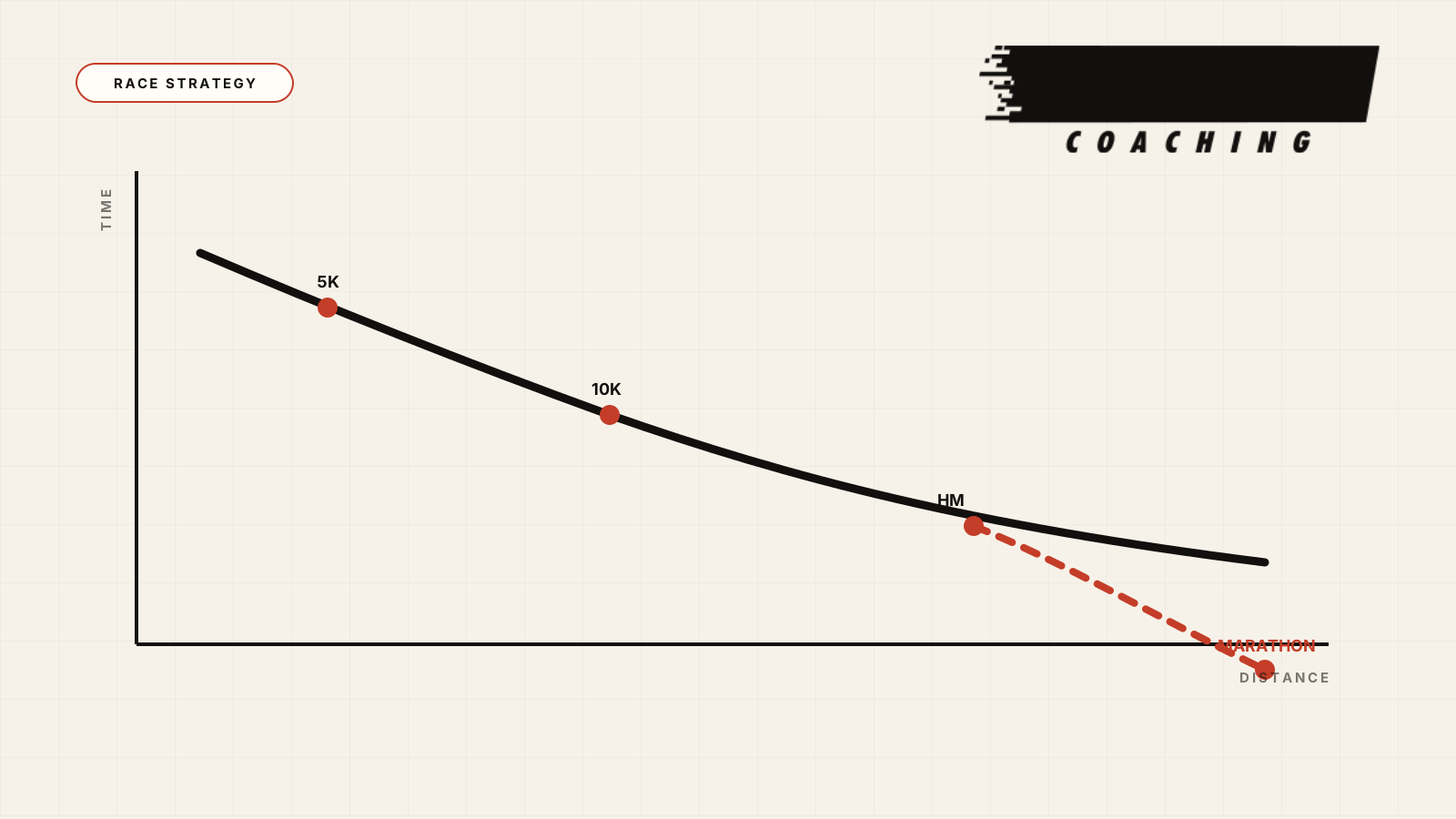
Over longer distances, a small early intensity mistake can cost much more later. Consistent preparation, long runs, fatigue resistance, temperature and fuelling become more important than running the opening kilometres quickly.
In a study of 139 recreational marathon runners, greater endurance-racing experience and higher weekly training volume were associated with less second-half slowing. This does not prove that more volume guarantees better pacing. It reinforces that your race plan must rest on the preparation you actually completed.
How to use the Split Calculator
The Split Calculator converts your target into Even Pace or Negative Split splits.
- Under
RACE DISTANCE, choose5K,10K,Half Marathon,MarathonorCustom. - Under
TARGET, selectFinish TimeorPace /km. - Under
SPLIT EVERY, choose1 km,5 kmor your ownCustomdistance. - Under
PACING STRATEGY, chooseEven PaceorNegative Split. - For negative splits, choose
Conservative – 2%,Moderate – 4%orAggressive – 6%underPROGRESSION.
The 2%, 4% and 6% options are neither research guidelines nor individual recommendations. They describe the total linear pace change from the calculator’s first split to its last.
For example, over 10K targeting 40:00 with 1 km splits, Moderate – 4% starts around 4:05/km and finishes around 3:55/km. The 4% concerns the first-to-last split difference, not the difference between race halves. Individual times are adjusted to total exactly 40:00.
Use Edit to adjust a split for a climb, descent or aid station. The calculator organises splits mathematically. It does not know whether your target is realistic, your fitness or race-day conditions.
Train for the whole race execution, not just a fast finish
You can practise negative splits without turning every session into a race. Depending on your training phase and level, use:
- easy or steady runs with a controlled pace increase towards the end,
- longer race-pace sections after controlled aerobic work,
- fast-finish long runs when they serve the training block’s purpose,
- simulations testing pace, fuelling and equipment together.
The goal is not to finish every session as fast as possible. Learn to recognise whether early intensity is controlled and whether you can increase pace without excessively compromising breathing, running form and overall session execution.
Key takeaways
- A negative split means a faster second half, but does not by itself prove good pacing.
- An excessively fast start increases the risk of substantial slowing later.
- An excessively slow start may leave time you cannot recover.
- On a flat course, start near target pace with controlled effort and increase progressively only if race information and your condition allow it.
- Even pace does not always mean even effort. Adjust splits for gradients, wind and temperature.
- The calculator’s 2%, 4% and 6% options are mathematical scenarios, not race-strategy rules.
- Your target must be supported by preparation, not just a desired finish time.
Use the Split Calculator to compare Even Pace with different Negative Split scenarios. Before finalising splits, check that you have chosen a realistic race pace based on recent training, course and conditions.
Sources and further reading
- Abbiss CR, Laursen PB. Describing and Understanding Pacing Strategies during Athletic Competition. Sports Medicine. 2008.
- Gosztyla AE et al. The impact of different pacing strategies on five-kilometer running time trial performance. Journal of Strength and Conditioning Research. 2006.
- Lima-Silva AE et al. Effect of performance level on pacing strategy during a 10-km running race. European Journal of Applied Physiology. 2010.
- Swain DP et al. A model for predicting the pattern of race pace during a marathon. Journal of Strength and Conditioning Research. 2020.
- Smyth B. How recreational marathon runners hit the wall: A large-scale data analysis of late-race pacing collapse in the marathon. PLOS ONE. 2021.