You ran the Athens Marathon in November in four hours. Now you are thinking about running the Athens Half Marathon in 1:50. Is that a realistic target for you? And if you decide to go for it, what should your watch show when you pass the 10 km mark? To answer these questions, I looked at the results of runners who completed both races, as well as the splits recorded by half-marathon finishers in 2025 and 2026.
I ran the Athens Marathon. What time should I use as a reference for the half marathon?
For a 4:00 marathon, the Athens Half Marathon Target calculator gives a typical time of 1:46 for the following Athens Half Marathon. The central estimate range is 1:42–1:49. So if you had 1:50 in mind, your target is realistic and close to times achieved by other runners with a similar marathon result. Before keeping or changing that target, it helps to understand where these numbers come from.
I compared each runner’s net time in the November marathon with their net time in the March half marathon. This produced 1,585 pairs of results. Some runners competed in all four races across the two years. I kept results from races with relatively balanced pacing, so that a major slowdown in the second half of the marathon would not become the reference for your next race. The comparison applies to this sample and these two specific courses.
The 1:46 is the typical half-marathon time the tool estimates for a runner who finished the Athens Marathon in 4:00. The 1:42–1:49 is the central estimate range: a band around that typical time showing how performances vary among runners with similar marathon times. Results outside this band, both faster and slower, are to be expected. Use it as a reference for your target alongside your recent performances and the preparation you have done.
With the Athens Half Marathon Target calculator, all you need to enter is your net marathon time. If you already have a half-marathon target in mind, you can optionally enter that too, to see how it compares. The second tool, the Athens Half Marathon Split Calculator, is the next step. Enter the time you have chosen for the 21.1 km and it shows roughly how long it would take you to reach each intermediate timing point.
Why do other calculators predict 1:55 for the half marathon from the same marathon time?
One widely used conversion method is the Riegel formula. It takes your finish time over one distance and calculates how your pace would change over another. In its classic form, with an exponent of 1.06, a four-hour marathon gives roughly 1:55 for a half marathon. You get the same answer whether you ran those four hours at the Athens Marathon or on a flat marathon course. The formula knows the distances and the time you entered.
The Athens Half Marathon Target calculator answers a more specific question. Given a finish time at the Athens Marathon, what time did runners typically achieve at the Athens Half Marathon in March? The difficulty of these two specific courses is reflected indirectly in the results. The Athens Half Marathon Target calculator does not read elevation profiles to subtract a set number of minutes from the Riegel estimate. The hills matter, but training and weather also change over the four months between the races.
Which estimate came closer? In the 481 pairs of results held back for testing, the mean absolute difference from the actual finish time was 5.5 minutes for the Athens Half Marathon Target calculator and 12.3 minutes for Riegel. For this particular pair of races, I would therefore use the Athens Half Marathon Target calculator as a starting reference. The 5.5 minutes describes the average size of the error in the independent test. If your estimated time is 1:46, that does not mean the largest difference you can expect is five and a half minutes.
How should I assess my Athens Half Marathon target?
Suppose you enter a 1:45 half-marathon target alongside your four-hour marathon finish time. The Athens Half Marathon Target calculator calls it a “Realistic target”. Its estimate is that roughly 4 in 10 runners with a similar marathon performance achieved that time or ran faster. This is a rounded comparison based on historical results. It would be a mistake to read “4 in 10” as “I have a 40% chance of running 1:45”. The tool knows the time you achieved at the marathon in November, but only you know what preparation you have done since then.
Think of two runners who finished the marathon in the same time. One kept training regularly and recently ran a good 10 km race. The other trained inconsistently. If they both enter 1:45 as their target, they get the same result. For the first runner, though, I would check whether the target pace also fits what they have shown in recent training. For the second, I would give more weight to how long they can currently run comfortably and consistently.
Read the “Conservative” and “Ambitious” labels in the same way. They tell you how common your chosen time was. If the target is a long way off, such as a 1:25 half marathon after a 4:00 marathon, the tool reaches beyond the range where it can make a reliable numerical comparison. A recent race performance is what can tell you whether that target is justified.
What if I did not run the marathon, or faded badly in the second half?
If you ran well up to halfway and then had to walk a substantial amount, your finish time accurately describes your day, but it is difficult to compare with the races used to develop the Athens Half Marathon Target calculator. The first half of a marathon is not a separate, all-out half-marathon race. In that situation, I would set the conversion aside and start with a recent race and the training you can complete now to estimate a target finish time.
One way to understand the limit of the comparison is to look at your two marathon halves. If you reached halfway in 1:45 and needed 2:15 for the second half, your total time would still be 4:00. But the second half took almost 29% longer. That slowdown exceeds the 20% threshold used to select races with relatively balanced pacing. I would therefore not use the 1:46 from the Athens Half Marathon Target calculator as an estimate of your half-marathon finish time.
If this is your first Athens Half Marathon, choose a target finish time based on your current fitness and use the Athens Half Marathon Split Calculator to see your splits. For example, if your recent training supports a 1:50 finish, you can look at those splits without having run the Athens Marathon first. If your biggest uncertainty is how you will feel after 15 km, allow a larger margin when choosing your target time. The fact that the tool can give you splits for a 1:45 half marathon does not tell you whether you are ready to achieve it.
For a 1:50 finish, where should I pay attention to the course and what splits should I expect?
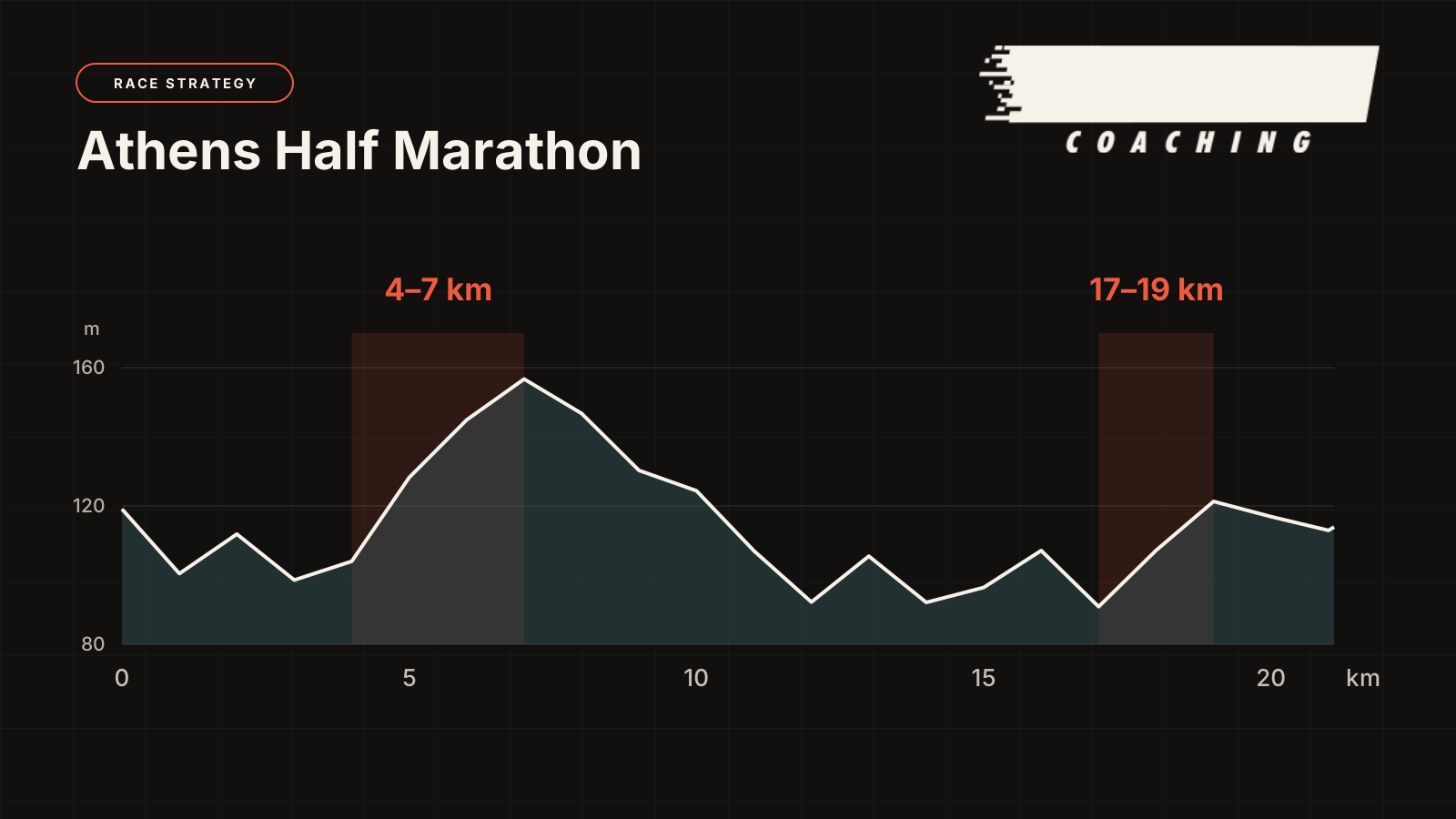
The average pace for 1:50 is 5:13/km. In the recorded Athens Half Marathon course profile, the first kilometre is generally downhill. The gradient then varies, with a gentle, sustained climb from roughly 4 to 7 km. So when you pass the first timing point, there is still some climbing ahead. If you see your pace slowing while your effort rises, there is no reason to push harder just to hold 5:13/km.
The Athens Half Marathon Split Calculator combines the elevation profile and timing-point positions with splits from 4,300 race entries with relatively balanced pacing. In the table, the middle column is the total time since you crossed the start line. The last column is the average pace for the section you have just completed.
| Section | Cumulative time at the end of the section | Average section pace |
|---|---|---|
| Start–5 km | 26:00 | 5:10/km |
| 5–10 km | 51:13 | 5:12/km |
| 10–15 km | 1:17:05 | 5:09/km |
| 15–20 km | 1:44:56 | 5:22/km |
| 20 km–finish | 1:50:00 | 5:04/km |
After the climb, from roughly 7 to 12 km, the course heads downhill. You can let your pace become faster there. Be aware, though, that the 5–10 km section includes both the end of the climb and part of the descent. Its average pace of 5:12/km is therefore not necessarily the pace to hold in every kilometre. You should not try to maintain the same pace in the sixth and ninth kilometres simply because they belong to the same timed section.
Across both years and the different finish-time groups, runners covered 10–15 km faster than their overall average pace and 15–20 km more slowly. There is another climb at roughly 17–19 km. If you pass 15 km in 1:17:05 and later see 5:22/km, you may be exactly where you should be. From a coaching perspective, I would save enough energy to keep running well and strongly through that final climb, rather than try to bank time on the descents.
From the 20 km timing point, there are roughly five minutes left to the finish in our example. If you feel you can increase your pace and effort, you can assess that with only about 1 km remaining. The faster final section comes from the calculated splits for a 1:50 finish. You do not need to base your target on a hypothetical finishing sprint to run the race “correctly”.
How close should I be to the splits? What if I lose time at the start?
The splits from the Athens Half Marathon Split Calculator are indicative times to help you plan your race. In the independent test I carried out for this tool, 1,294 results were used and the mean absolute difference at the four intermediate timing points was roughly 51 seconds, compared with 64 seconds when splits were calculated at a constant pace.
Suppose you are aiming for 1:50 and pass 5 km in 26:30 instead of the 26:00 in the table. Before trying to recover that half-minute, consider how you feel and why you lost the time. If you had to slow down because of crowding but your effort is still controlled, you can continue with your race plan. If you have already had to push hard to reach 26:30, though, you should reconsider the pace you are trying to maintain.
The option to show split ranges helps you see how much times can vary at each checkpoint. For 1:50, the range at 5 km is 24:37–27:24. I would not choose its faster end as a target to gain time early on. The ranges apply to each checkpoint separately and do not form a second set of splits to follow throughout the race.
To compare your splits properly, start your watch when you cross the start line. That is when your net time begins. The wait before you cross the line does not count towards it. If you have to walk or slow down after crossing the line because of crowding or any other reason, that time does count towards your total.
Avoid repeated accelerations and sudden changes of direction to pass other runners. Once you have more room, gradually return to your planned pace, adjusting it to the changing gradients. If you try to recover 30 seconds in the next kilometre, you have to run that kilometre 30 seconds faster than planned while you are still climbing. Spread that time over the roughly 16 km remaining, however, and it amounts to less than two seconds per kilometre. There is no need to rush to make up the difference.
Check your cumulative time as you cross the official timing point, even if your watch’s GPS reached 5 km a little earlier. Turns, the line you run and the signal between buildings affect the distance your watch records. In the table, each section’s pace is calculated using the estimated actual distance between timing points. To compare your splits, use the cumulative time in the middle column.
How does wind affect my pace?
The Wind Pace Calculator helps you estimate how your pace may change in a headwind, crosswind or tailwind while maintaining the same effort.
For example, I entered a reference pace of 5:00/km in still air, a runner’s weight of 68 kg and a wind speed of 25 km/h, using the “Suburbs” setting for moderate shelter from the surroundings. For the same effort, the tool gave roughly 5:29/km into a headwind, 5:04/km in a crosswind and 4:52/km with a tailwind.
On the Athens Half Marathon course, you change direction several times. Shelter from buildings also varies from street to street. You therefore cannot multiply the 29-second headwind penalty by 21 km to work out your total delay. Use the tool to see how your effort is affected by different wind directions and levels of exposure on particular sections of the course, rather than across the race as a whole.
During the race, if a headwind forces you to work much harder to hold your planned pace, adjust that pace and allow yourself to slow down. When you change direction or reach a more sheltered street, reassess your effort before accelerating to recover the time you lost.
How much can heat cost me? What did we see in the two editions?
The Heat Adjusted Pace Calculator gives an initial estimate of how temperature and relative humidity affect your pace. In “Cool effort → Heat pace” mode, you can enter the pace corresponding to your effort in cool conditions and see how it changes in warmer weather.
For example, at a pace of 5:00/km, a temperature of 22°C and relative humidity of 70%, the tool gives roughly 5:06/km for the same effort. If that change applied across the full 21.1 km, the difference in finish time would be roughly two minutes.
The model is based on marathon results, and its creator also recommends it as an indicative estimate for other sustained efforts. Race duration, heat acclimatisation and exposure to the sun affect your individual response. Use it to reconsider your target finish time based on the weather expected on race day and at the time you will be running. If the temperature is forecast to rise, also try the values expected towards the end of the race.
In the two editions we examined, the Theta-M weather station, roughly one kilometre from Syntagma Square, recorded an average temperature of 17.4°C with 33% humidity in 2025 and 13.3°C with 60% humidity in 2026, during the first three hours after the first start. According to the Heat Adjusted Pace Calculator, these two combinations of temperature and humidity correspond to similarly low heat stress, so we would not expect weather conditions to have a large effect on finish times. In our selected sample, the median finish time was also almost identical: 1:51:41 in 2025 and 1:51:38 in 2026. This is consistent with the small difference estimated by the Heat Adjusted Pace Calculator.
How should I use the tools for my preparation and race?
Start by choosing a target finish time supported by your recent performances and preparation. If the Athens Marathon was representative of your fitness and you ran it with relatively balanced pacing, the Athens Half Marathon Target calculator gives you a useful initial estimate. Then check the expected weather and use the Athens Half Marathon Split Calculator to calculate your splits for the time you ultimately choose.
For example, Level 1 assumes that you already run consistently three times a week, can comfortably run for 30–40 minutes without stopping and have time for 3–4 training sessions a week. Your desired race time alone is not enough to choose a plan.
During the race, compare your cumulative time with the indicative splits, taking the gradient, weather and how hard you are working into account. For a 1:50 target, reaching 5 km in 26:30 with controlled effort may be preferable to hitting 26:00 if you have already had to push too hard to achieve it. The aim is to manage your effort all the way to the finish, adapting your pace to the demands of the course.