You have crossed the finish line after 42.195 km and several months of preparation. You may already want to enter your next race. Or you may not even want to look at your running shoes for a few days. Before deciding when to do your next hard session, it is worth making room for recovery and considering what you can take away from the experience.
Feeling less sore does not tell you everything
After a marathon, it is easy to judge your condition by how you manage the stairs. As the soreness fades, you feel ready to return. But recovery involves more than that feeling.
For example, Asp et al., 1999, followed six trained marathon runners and found that muscle glycogen was still below pre-race levels on the second day, despite a carbohydrate-rich diet. It had returned to baseline at the next measurement, on day seven. This does not establish a common recovery day for everyone. It shows why replenishing your stores after a marathon can take longer than you expect. Asp et al., 1999
In practice, we consider fatigue, sleep, mood, discomfort and how you respond to everyday movement together. A runner who finished feeling in control and someone who struggled badly over the final 10 km do not necessarily need the same return to training, even if they ran the same time.
For a few days, keep some simple notes: how you slept, how tired you feel and whether discomfort or muscle soreness is easing. Watching your progress from day to day is more useful than relying on a number on your watch.
Prioritise the basics in the first few days
Recovery starts with things we often take for granted: enough food, fluids, sleep and fewer demands on your body. Carbohydrates help replenish glycogen, while protein supports muscle recovery processes. You do not need to cut either abruptly because you will be running less this week. Kerksick et al., 2017
Practical options for continuing to eat well include a regular meal with rice or potatoes and a source of protein, or yoghurt with fruit and cereal. If your stomach is sensitive after the race, start with portions and foods you can tolerate and eat again later in the day.
Make more room for sleep, too. If you were getting up at 05:30 to fit in training, there is no reason to keep waking that early on your rest days, provided your other commitments allow it.
A little comfortable walking can fit into your day if it does not increase discomfort. Avoid turning “active recovery” into another demanding workout. Even if you choose cycling or swimming instead of running, the intensity and duration still matter.
Return to running according to your response
There is no single number of days that correctly answers “When can I return to training?” for every runner. Some evidence does not support mandatory complete rest for everyone: in a study of 64 marathon runners, Martínez-Navarro et al., 2021, found no worsening of muscle damage markers with a specific running programme that began 48 hours after the race. However, this does not prove that every runner is ready to resume normal training 48 hours after a marathon, or that injury risk has been ruled out. Martínez-Navarro et al., 2021
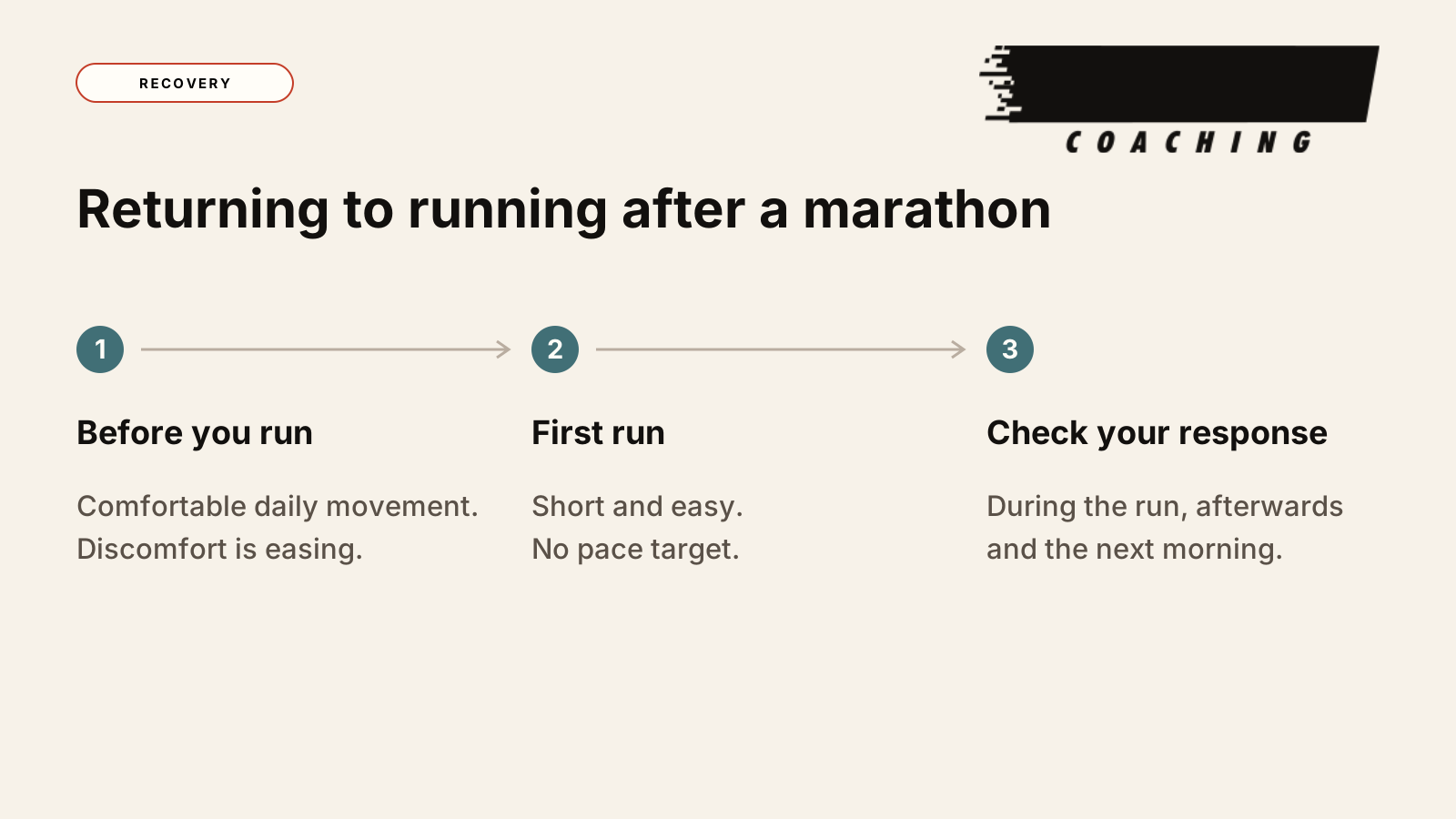
In practice, before trying a run, you want everyday movement to feel comfortable and any discomfort to be easing. Your first session should be short and easy, with no pace target. If you normally run for 60 minutes, you can start with less, for example 20–30 minutes or shorter, depending on how you respond.
Notice how you feel during the run, later that day and the following morning. If fatigue or discomfort increases, you need to give your body more time to recover. First establish a comfortable return to training, then gradually increase its demands. Fast intervals and a big long run can wait.
Pain localised to one area, pain that changes your running gait, or symptoms that persist and get worse need assessment by a healthcare professional. Do not treat them as something that will simply go away with more running.
Review the race beyond your finish time
Once the first few days have passed and you can look at the race more calmly, note what worked and what you would like to change. Your finish time is useful, but it does not explain the effort on its own.
How did you start? Was the intensity what you had planned? When did you begin to struggle? Did you follow your fuelling plan? Was there any discomfort or a condition you had not accounted for?
If your pace dropped noticeably after 30 km, it is not enough to conclude that you needed more mileage in training. You need to consider your start, how you managed pace and effort on the hills, the weather conditions and your fuelling together. Particularly in Athens, two sections with different gradients cannot be compared on pace alone. The data helps when you read it in the context of the race as a whole.
Keep a record of what went well, too. Perhaps you managed the start better, fuelled consistently or stayed focused when things became difficult. Those are worth noting so you can carry them into your next preparation.
Before setting your next time goal, you can also read the article on realistic race pace. Reviewing your race becomes valuable when it helps you make specific decisions about what comes next.
Plan your next goal with room for recovery
A spring half marathon, a 10 km race or another marathon at a different event could be your next goal. First consider how long you have until the race, your starting condition and how many sessions you can consistently support in a way that realistically fits your everyday life.
The length of a training plan helps you work out when to begin. If your next half marathon is in mid-March, a 16-week plan starts around late November. Calculate the start date using your own race’s official date and the length of the programme you will follow.
The fact that the plan starts then does not mean you should rush to be ready. You need to have recovered from the marathon and be able to meet the demands of its first few weeks. If you need more time, reconsider the goal or your approach rather than squeezing in the sessions you missed.
If you prefer to follow a ready-made training programme for your next goal, you can explore the Training Plans I have designed based on my experience in 1:1 coaching. Their weeks and sessions have been designed as a whole, with clear guidance on duration, intensity and execution. Look for the one that fits your distance, starting point and available time, so you can organise your preparation for your own race.
You can decide on your next goal now and give yourself the time you need before you start pursuing it.
What to take away
-
Assess recovery using more than muscle soreness alone.
-
Make room for food, sleep and rest before increasing your training again.
-
Monitor your response on the day after each run, too.
-
Take specific lessons from the race into your next preparation.
-
Work out how many weeks you have until your next goal without skipping recovery.
Sources
-
Asp et al., 1999. Muscle glycogen accumulation after a marathon: roles of fiber type and pro- and macroglycogen. Journal of Applied Physiology, 86, 474–478.
-
Martínez-Navarro et al., 2021. The week after running a marathon: effects of running vs elliptical training vs resting on neuromuscular performance and muscle damage recovery. European Journal of Sport Science, 21, 1668–1674.
-
Kerksick et al., 2017. International society of sports nutrition position stand: nutrient timing. Journal of the International Society of Sports Nutrition, 14, 33.