Cycling VO₂max Calculator
Estimate your VO₂max in ml/kg/min from the average power of a maximal 5-minute cycling effort and your body weight.
5-minute maximal effort
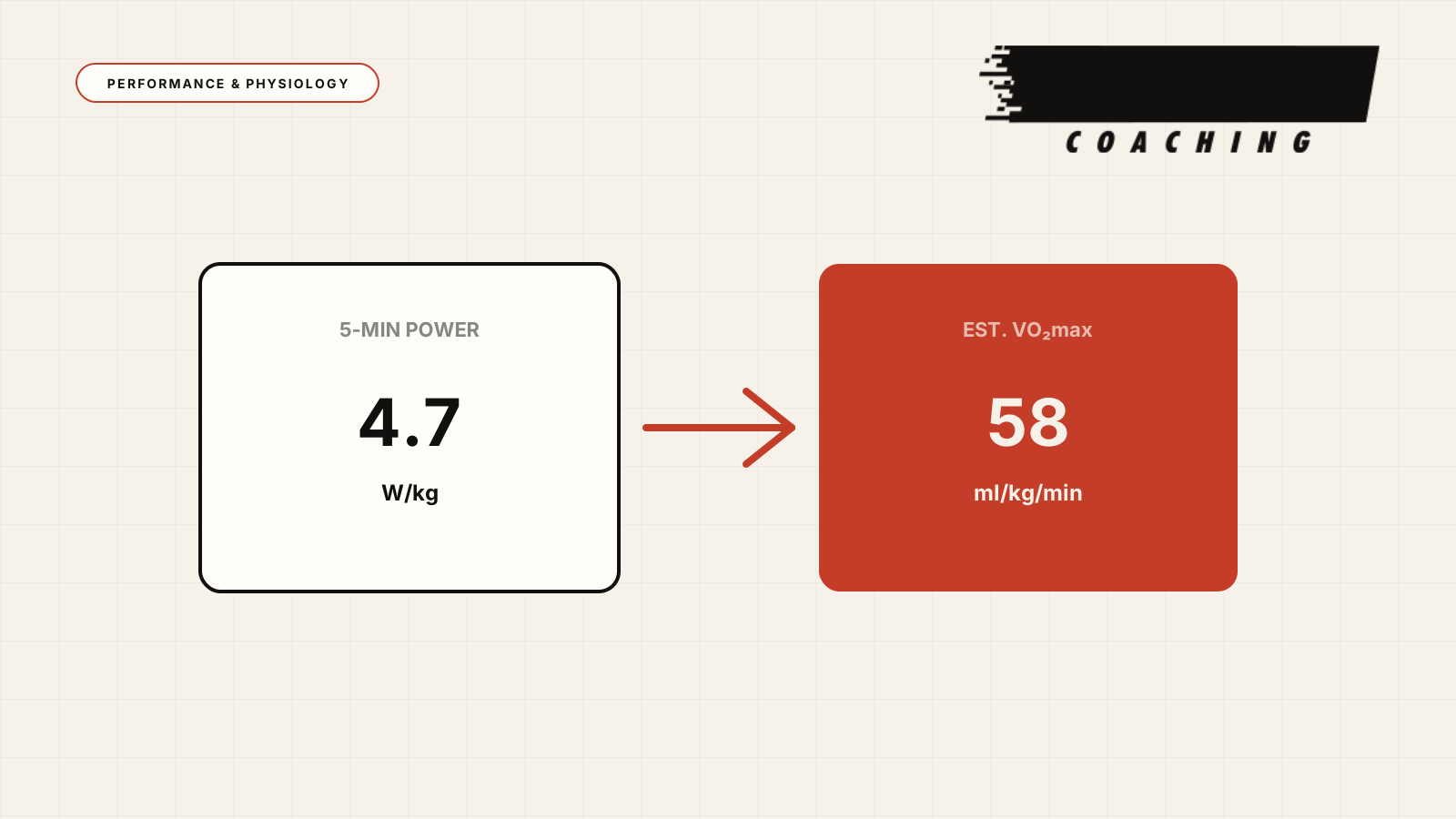
5:00 · 330 W · 70 kg · 4.71 W/kg
- Absolute
- 4.09 L/min
VO₂max 58.4 ml/kg/min
How to use it
Enter average power in watts for the full maximal 5-minute effort and your body weight. The effort should be well paced and performed in representative conditions with reliable power measurement. The calculator shows estimated relative VO₂max in ml/kg/min, the corresponding absolute value in L/min and the effort’s power in W/kg.
What you need to know
This is a mathematical estimate, not a cardiopulmonary exercise-test measurement. Accuracy depends on whether the effort was truly maximal, pacing, fatigue, recovery, power-meter calibration and test conditions. The equation is designed for average power from a 5-minute effort. Do not use a shorter or longer duration as though it were the same protocol.
Read the related article
VO₂max measures aerobic capacity, not your entire performance.
A high VO₂max indicates strong aerobic capacity but does not determine race performance on its own. Threshold, endurance, economy, pacing and the ability to sustain a high percentage of VO₂max are equally important. Together, we can assess your data and organise training to turn your VO₂max into real race performance.
Methodology & Sources
The estimate uses the Sitko et al. equation for a maximal 5-minute cycling time trial: VO₂max (ml/kg/min) = 16.6 + 8.87 × 5-minute W/kg. W/kg is average power over the entire 5-minute effort divided by body weight. Absolute L/min is calculated from relative VO₂max and body weight. The equation is a population-level prediction model, not a direct physiological measurement. Results display one decimal place for ml/kg/min and two for L/min and W/kg.
Last updated: 8 July 2026