Critical Power Calculator
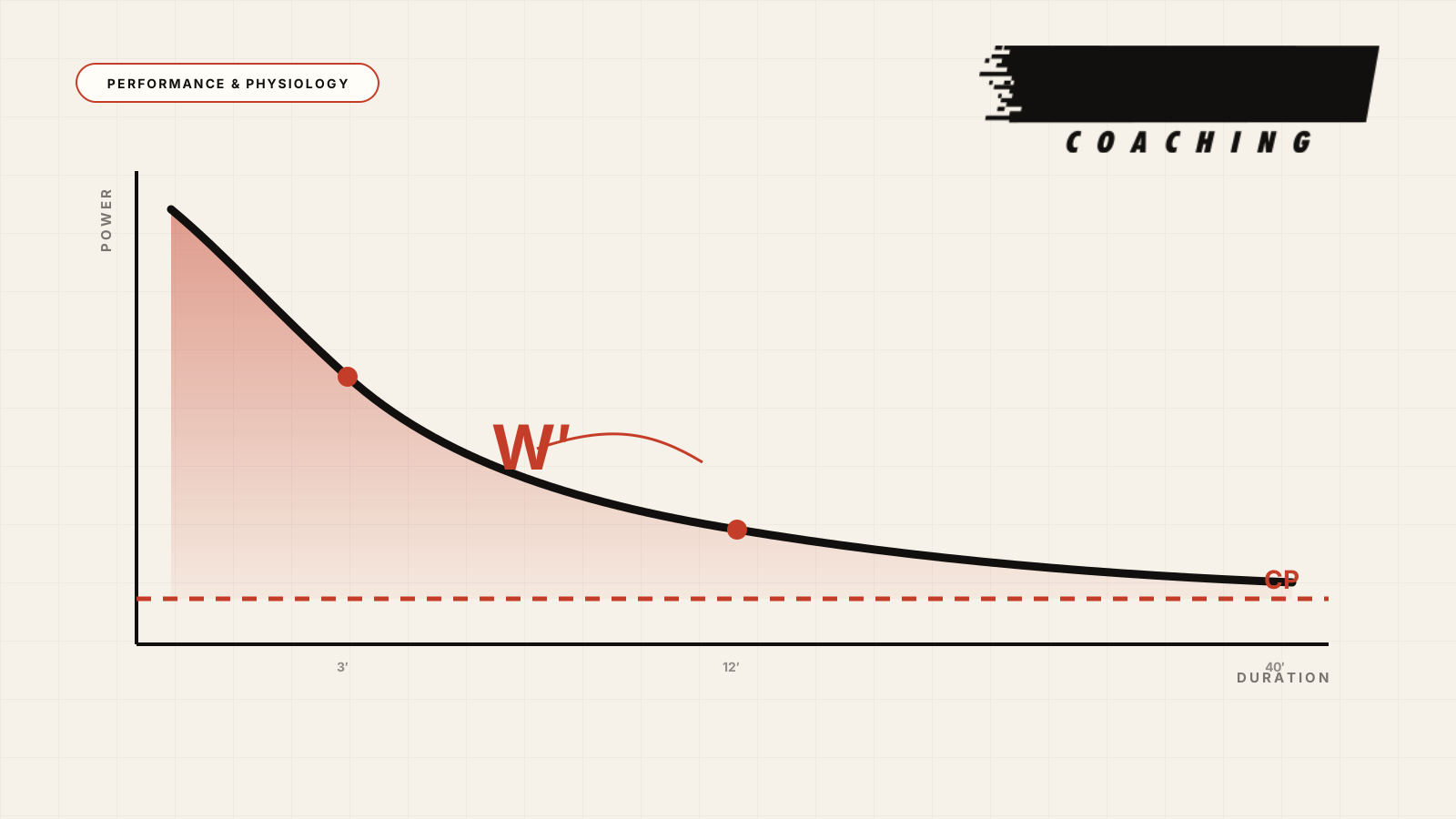
Calculate Critical Power (CP) and W′ from 2–4 maximal cycling efforts of different durations. Use the model to estimate watts for a given duration or duration at a given wattage.
Effort 1
Effort 2
Critical Power (CP) 293 W · W′ 19.2 kJ
- W′
- 19.2 kJ
| Duration | Power |
|---|---|
| 3:00 | 400 W |
| 5:00 | 357 W |
| 8:00 | 333 W |
| 12:00 | 320 W |
| 15:00 | 315 W |
Critical Power (CP) 293 W
How to use it
Enter duration and average power in watts for 2–4 maximal cycling efforts. For a better estimate, use at least three efforts covering different parts of the power–duration curve: one short effort of 2–5 minutes, one medium effort of 6–9 minutes and one long effort of 10–15 minutes.
What you need to know
Predictions describe a simplified two-parameter power–duration model. They do not guarantee performance and become less reliable outside the range of the efforts entered. All efforts must be maximal and independently paced; poor pacing, fatigue or inadequate recovery distort CP and W′. CP is not FTP. W′ is model-derived finite work capacity above CP, not a direct energy measurement.
Read the related article
Explore 1:1 Coaching
Critical Power separates the heavy and severe intensity domains. With your CP, we design interval sessions such as HIIT and over-unders that target your energy systems with absolute precision.
Methodology & Sources
Two-parameter power–duration model: P = CP + W′/t, fitted as linear regression of average power in watts against 1/t (Monod & Scherrer 1965). Two efforts give an exact solution; three or four use ordinary least squares. CP is the model’s asymptote; W′ is finite work capacity above CP. Power prediction: P(t) = CP + W′/t. Time prediction: t = W′/(P − CP) for P > CP. Results do not constitute laboratory validation.
Last updated: 8 August 2026