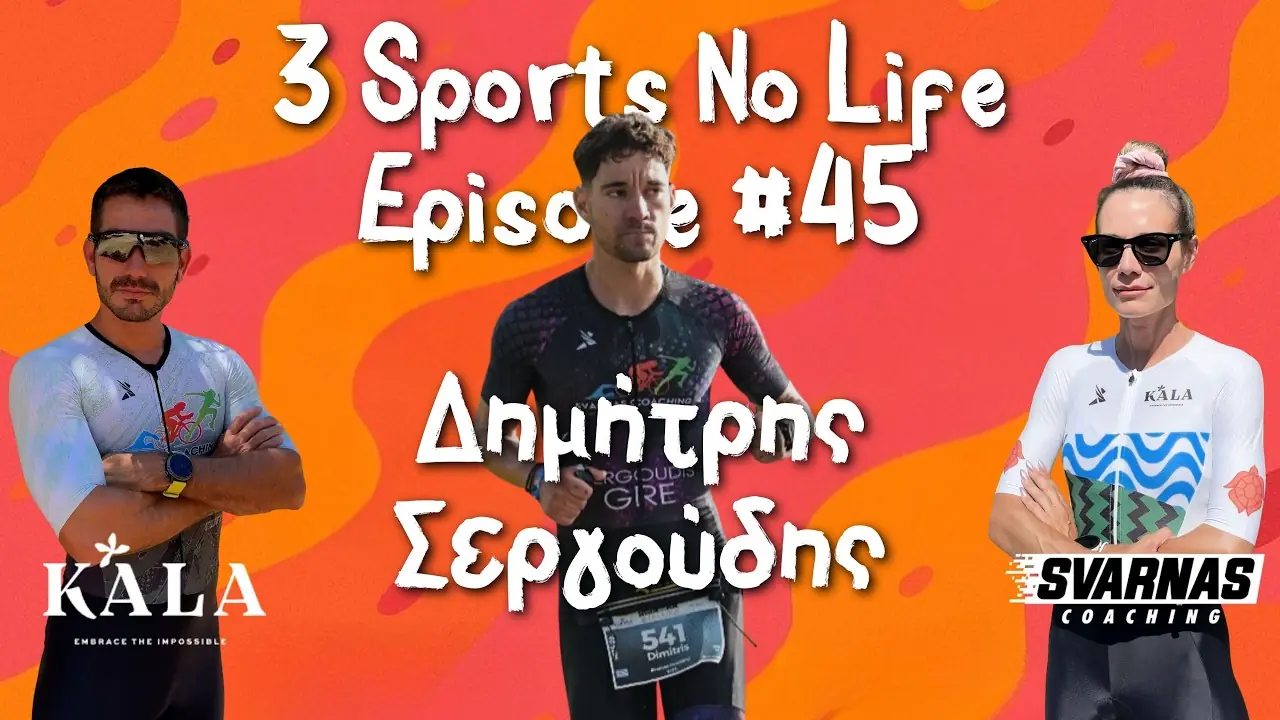
In this episode
Dimitris Savvidis, 34, has lived and worked in the Netherlands for seven years. He introduces himself first as a husband and father, then as someone who found through exercise the energy and calm he had missed in Greece.
His journey includes military service, the Athens Marathon, an inexpensive aluminium bike, an uncoached 70.3 in Venice and Ironman-distance races in Frankfurt and Hamburg. Time management, family and Dutch sporting culture remain central.
Quick navigation
- 00:00 — Introductions
- 02:10 — Family and life in the Netherlands
- 05:39 — From marathons to Ironman
- 11:24 — What Ironman means beyond the stopwatch
- 15:23 — Daily life, training hours and culture
- 25:34 — Deciding to move abroad
- 28:33 — Frankfurt, Hamburg and fuelling
- 35:36 — Future races, children and closing remarks
Detailed show notes
A husband and father first
Dimitris Savvidis does not begin with an engineering CV. He says he is 34, a husband and father, lives in the Netherlands and now feels at peace. In Greece, he felt out of place professionally and socially. Seven years later, he still appreciates the courtesy and seeing people exercise at any hour: running, cycling, handcycling, with pushchairs and on scooters.
A marathon without a watch, an Ironman with a coach
Running began during military service. His first “crazy idea” was a marathon. He could not sleep from nerves the night before; he ran the Athens Classic Marathon as a beginner whose longest run was 30 km. Crete and Thessaloniki followed. He was not racing for time, but collecting experiences and brief conversations along the route.
Triathlon arrived when a close friend did an Ironman. He bought a €200 second-hand aluminium bike in the Netherlands and appeared at his first Olympic-distance event with a lock, light and phone holder. After a pandemic postponement, he did his first 70.3 in Jesolo without a coach. He ran out of energy on the run, having eaten almost nothing during the 90 km bike.
Two Ironman-distance races, the same person
He hired a coach after realising middle and long distance are about energy management. His first Ironman in Frankfurt felt easier than that 70.3. In Hamburg in 2025, he improved by more than an hour, with better test results, familiarity with the lake and a salt protocol he followed this time.
He requested a plan fitting his available time: almost daily training, one rest day, sessions of 1–2.5 hours and around seven hours weekly as a minimum. He is not chasing qualification.
Making room for training by cutting wasted time
Television is not part of his routine. He returns around 17:30, eats with his family and the child goes to bed at 20:30. Training starts then; if he handles bedtime, he may begin at 22:00. After a long bike or double session, he has gone to bed past midnight. He does not recommend this as a model; it was the only time he could find.
His Dutch employer encourages work–life balance: they go running at 12:00 on Tuesdays and Thursdays. People exercise in rain or snow. For his next full, he is considering flat courses and a family holiday; his coach advises against doing one every year.
A child sees what you believe they can do
Every finish with a hug for his wife leaves a smile. With his two-and-a-half-year-old daughter, he does little bike rides, running games and pool visits. He sees the image you build in a child’s mind as more important than fear. He closes by saying the change you want in the world begins with becoming the example yourself, without the excuse of “not having time”.
Key takeaways
- For an amateur with work and a child, long distance fits by reducing passive time, not waiting for an ideal schedule.
- Without a fuelling plan, a good bike cannot save the run.
- Fewer targeted hours with power data, water familiarity and a consistent protocol can cut an hour between races.
- Dutch daily life helps, but the message is not to move abroad; exercise becomes culture when you see it around you and in your child.