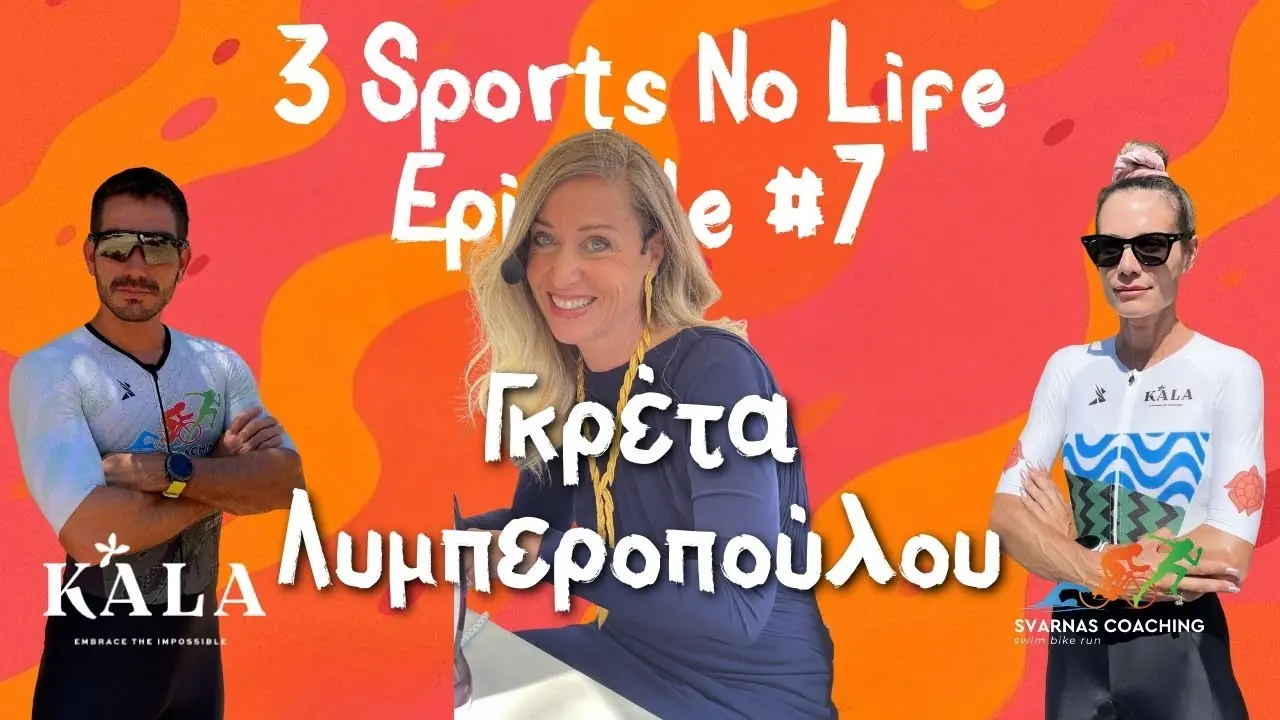
In this episode
Maria Trakada lives in Athens, works eight-hour days in marketing and is preparing for her first Ironman in Italy in September, 107 days after the recording.
She discusses two halves, cycling anxiety, wanting more women her age in the sport, and speaks openly about periods and an eating disorder.
Quick navigation
Detailed show notes
From “I don’t run” to an Ironman goal
Around 29, based in Athens and working in marketing. She did ballet as a child and only weight training at 21. She heard about triathlon at the gym from George, who became a Panathinaikos teammate. Running began during lockdown. In 2022, she told her partner Kostas, “I’m going to do an Ironman”.
Her mother’s partner is another motivation: he lost weight, ran a marathon in 2019 and died during training in 2020 while hoping to learn to swim for an Ironman. Maria is collecting the letters on Athens Marathon medals; she still needs the Greek letters Y and N, without having run a marathon yet.
Two halves and a week with weights
Two halves: Vouliagmeni 2023, with its hilly run, and Messolonghi. She took a break after the first; cycling wore her down, and she also developed styes at the pool. She did not want to jump straight to Ironman distance. She loves sprint racing; Olympic distance appeals less.
She wakes for weights, works, then trains for triathlon. Weights 5–6 times weekly, swimming twice, cycling three times and running 3–4 times including a brick. Weight training takes a toll in the water if she has missed swim days. For Italy, she has around six hours in mind for the bike and does not want to start the run fast. Fuelling worries her.
Women, periods and control
On social media, she also shares the week she cried over an inner tube, not just Sunday’s 100 km. She wants more women her age in the sport and age groups. Heavy training can stop periods; she does not treat this as taboo.
As an adult, she experienced anorexia nervosa during a transition after her studies: controlling food compensated for uncertainty. Weight training helped keep her from reaching a very low weight. She lost her period for years. In triathlon, combining too little food with extensive training backfired; she used reverse dieting. She loves swimming and running, while cycling makes her anxious and she cannot tolerate descents.
First races and what comes next
Her first race was in Nafplio, a sprint instead of the Olympic distance she had entered, with tears from anxiety. In Vouliagmeni, she considered stopping in the early run kilometres. In Messolonghi, Kostas told her she was on the podium although she had seen three women ahead; she cried at the finish. In the TRIMAN relay, she did only the run and paid for taking it lightly after the half.
She wants no more races before Italy. Afterwards, she is considering Kalmar and Thun in Switzerland. She says you do not need a perfect triathlon bike to begin; a second-hand road bike is enough.
Key takeaways
- Everything need not be perfect to begin triathlon; equipment can be built up month by month.
- Sprint, Olympic and half distance feel like different sports mentally; she likes the half because there is time to make adjustments.
- Periods and your relationship with food belong within preparation, not on the margins of social media.
- Cycling can be both the source of anxiety and the biggest opportunity to improve.