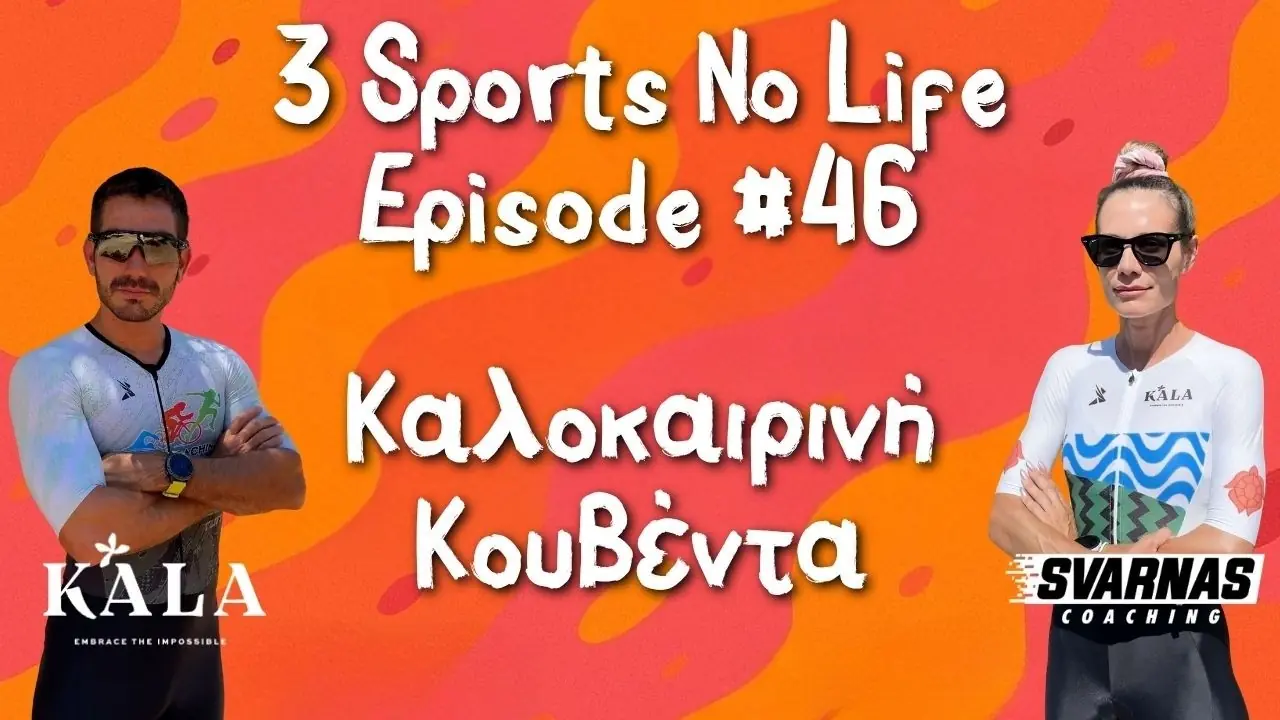
In this episode
Grigoris Souvatzoglou began in Haidari at five, moved into monofin swimming and stopped at 18. He sees triathlon as a hobby after elite competition, with his first official race in 2012.
The conversation covers Ironman distance and Kona, XTERRA/Maui and guiding in paratriathlon. It closes with coaching qualifications and the value of communication beyond a ready-made programme.
Quick navigation
Detailed show notes
Monofin swimming before triathlon
At five, he joined his sisters Magda and Ioanna at Haidari’s outdoor 50 m pool following medical advice for a breathing issue; he does not remember the exact diagnosis. He swam conventionally until 15, then switched to monofin swimming: surface swimming with a snorkel and 50 m underwater on one breath. At 17, he placed third and sixth in the men’s events at a world competition. He mentions a 1500 m result with a breathing cylinder of around 12:42–12:52. He stopped at 18.
Astroman 2012 and a hobby
His first official race was in 2012, the final Astroman over 70.3 distance, using a borrowed entry and a name he says is not in the results: first out of the water, fourth overall and second in his category. He considers his sport up to 18 elite competition, and triathlon from 24 a hobby without the pressure of feeling his life is being judged. He has worked consistently with the same coach since 2012. Sprint and Olympic races abroad gave him a wake-up call about the standard; he wanted to explore multisport formats, not ultras.
Ironman, Kona and the sea
At the Challenge/World Triathlon European event in Poznan around 2016–2017, racing elite, he describes an incorrectly measured swim—approximately 3 km rather than 3.8—and an 8:38 finish. He was second overall at Navarino in 2019. At Ironman Malaysia 2019, he finished in around 9.5 hours in heat and humidity, earning a slot he retained after Covid and used to race Kona in 2022. He arrived unprepared for the island and walked 20 km to earn the medal. Having worked as a lifeguard in Alimos, open water was familiar.
Guiding and coaching
He guided Gerasimos in paratriathlon, an experience requiring complete coordination and trust. They discuss visual impairment, previous pool experience, a tandem, a tether in the water and on the run, and always having the athlete cross the line first. He says they were first reserves for the Paralympics, without a wildcard. The custom tandem was delayed, and airline rules prevented one race. He began coaching swimming in 2014, completed ITU Level 1 in Loutraki and Level 2 in Hungary, attended cycling coach training because the World Triathlon qualification was not recognised in Greece, and was attending triathlon coach training on recording day. He keeps his athlete roster small to preserve communication.
Key takeaways
- Monofin is presented as finswimming with an international distinction at 17, as he recounts it, not an Olympic sport.
- Grigoris approaches triathlon as a high-level hobby, not a second elite career defining his life.
- Kona needs specific preparation; earning a slot and walking 20 km is not the same as a peak race day.
- A paratriathlon guide shares equipment, costs and pacing responsibilities; the athlete crosses the line first.